
The Harder You Work, The Worse You Think

A woman wrapped in a blanket reads a book beside floor-to-ceiling windows framing the rocky Cederberg landscape

There is a puzzle psychologists have been handing to people since the 1940s, and almost everyone fails it the same way. You are given a candle, a box of drawing pins, and a book of matches, and asked to fix the candle to the wall so that it burns without dropping wax on the floor. People try to pin the candle directly to the wall. They try to melt one side and stick it. Neither works, and they sit there turning the same three objects over, certain the answer is somewhere in the candle. It isn’t. The answer is to tip the pins out of the box, pin the empty box to the wall, and stand the candle inside it. The box was a shelf the entire time. The only reason it takes so long is that the box arrives full of pins, and a box full of pins is a container, and a container does not become a shelf until you decide it can.

Karl Duncker built that puzzle in 1945, and psychologists have been quietly running it ever since under the duller name of functional fixedness, the mind’s habit of seeing an object only as the thing it usually is. What matters here is not the puzzle. It is the discovery, made decades later, that the odds of solving it have very little to do with intelligence or effort, and a great deal to do with the state you happen to be in when you sit down.

In 1962 Sam Glucksberg ran the candle problem with a twist. He offered one group money to solve it quickly, a cash prize for the fastest times, the kind of incentive every workplace runs on. They were measurably slower than the group offered nothing. The reward narrowed them. It pulled their attention onto the obvious features of the objects and away from the strange one, the box, which was exactly where the answer lived. Twenty years later Alice Isen ran a gentler version. Before handing people the puzzle she gave some of them a small bag of sweets, or showed them a few minutes of a comedy film, nothing more than a minor lift in mood. Those people solved it faster and more flexibly than the rest. A good mood did what a cash prize could not.

This is the finding the productivity industry has spent the last few years discovering, repackaging, and selling back to exhausted people as a technique. The version most people have met by now comes from a young doctor turned productivity author who, on the edge of burning out as a junior medic, noticed the research and built a bestseller on it. The headline is appealing and mostly true: feeling good is not the reward for good work, it is the precondition for it. Barbara Fredrickson spent the late 1990s demonstrating exactly this, that positive states physically widen the aperture of attention, let more information in, and accumulate over time into durable reserves of resilience and range. The clenched mind is a narrow mind. The narrow mind misses the box.

You can see the same thing in the people who do the most consequential work of all. Richard Feynman traced his Nobel back to an afternoon spent watching a plate wobble in the air over a cafeteria, a problem nobody had set him and nothing depended on, which is precisely why he could think about it freely enough to find the rotation that later fed his work on quantum electrodynamics. Alexander Fleming described what he did as playing with microbes. Andre Geim and Konstantin Novoselov isolated graphene during what they called their Friday-night experiments, the hours they set aside to mess about with questions that had no deliverable attached. Ask any of them how it happened and they describe play, not grind. The grind is what the rest of us do to the work after the interesting part is over.

There is a researcher, Stuart Brown, who has spent a career arguing that play is not the opposite of work but the condition that makes good work possible, and that adults never lose their play temperament, they just stop being allowed to use it. And there is a study from 2020, run jointly by NYU and the University of Miami, that tracked people’s movements by phone and found that those who simply varied their days, a different route to the office, an unfamiliar café, reported more happiness and less of the flat grey that arrives before burnout does. None of this is exotic. It is the ordinary human range, the one that gets switched off first when the pressure goes up.

Which is where the productivity reading of all this falls apart. The genre takes the research and turns it into one more thing to manage. Schedule a side quest. Gamify the spreadsheet. Build delight into your sprint. The burned-out executive reads the play studies at eleven at night and resolves, tomorrow, to make the work fun, and in doing so adds a fifteenth item to a list of fourteen that already isn’t getting done. The studies do not say add play to a clenched system. They say the clenched system is the problem, and that you cannot instruct yourself into ease from inside the conditions that removed it. A reward could not buy Glucksberg’s people out of their own narrowness. Telling yourself to relax is just another reward.

What changes the state is almost never a technique. It is the removal of the conditions that produced it. That is the one thing no productivity book can give you, because the conditions are mostly the room you go back to on Monday, and they do not loosen because you have decided to be more playful inside them. They loosen when you are no longer in the room.

Why You Can’t Switch Off From Work

Woman with eyes closed floating in natural rock pool at Bliss and Stars Cederberg retreat, stone sculpture on edge beside her

You can’t switch off from work because the system that is meant to switch you off only stands down once it decides the threat has passed, and modern work is a threat that never quite passes. So the system stays on, low and constant, long after you have left the building. You call the result an inability to relax.

What rest actually is
Rest is broadly defined as freedom from activity, labour, or exertion, a state of repose meant to refresh or recover strength. The keyword being recover, because it tells you rest is not a reward you get for finishing a project. It is the process by which the thing that got depleted gets restored, and like any recovery, it needs specific conditions and it takes time.
Underneath this dictionary definition, there is a physiological version. The body runs two settings. One, the sympathetic, known as fight-or-flight, is the accelerator. It gets you ready to push, to act, to deal with the thing in front of you. The other, the parasympathetic, known as rest-and-digest, is the part that lets the body recover, repair, and stand down. Rest, physiologically, is the move from readiness into recovery. You can lie completely still on a beach with your whole system still running on the chemistry of getting things done, and you will not have rested at all. People prove this on expensive holidays every year.

So why can’t you switch off
The stress response is an old and useful piece of engineering. Something threatens you, the sympathetic system fires, hormones flood in, and you become briefly sharper and stronger and entirely focused on the threat. When the threat resolves the whole apparatus is supposed to switch off and let the body recover. The neuroscientist Bruce McEwen spent a career describing what happens when it doesn’t. He called the accumulated cost allostatic load, the wear and tear a body takes on when the stress response is run too often, for too long, and never properly shut down. The system was built for being chased by the lion and the quiet afternoon afterward. It was not built for a job that produces a steady supply of lions, none of them urgent enough to fully resolve, all day, for weeks or months on end.
And then there is the mind. The psychologist Sabine Sonnentag, who has studied recovery from work for decades, calls it psychological detachment: the experience of mentally disengaging from your job while you are physically away from it. Not just physically leaving the office but your mind leaving it too. Recovery only really begins once the demands stop, and the demands do not stop simply because you have gone home. They follow you. You are at dinner and you are thinking about tomorrow’s meeting. You are lying in bed and the mind still worries about the report you are behind on. As long as some part of you stays engaged with the work, the body reads it as the threat, and the recovery setting never gets the signal to come on.
So when you say you cannot switch off, you are describing something real and specific. You cannot detach. And you cannot detach because the conditions that demand your engagement are still present, even when the only place they are present is inside your own head.

Why a change of scene isn’t enough
This is why the beautiful escape so often fails to deliver, because detachment is mental, not geographic. You can move your body two thousand kilometres and still bring the work with you. The phone still has signal, so the line stays open, and an open line is an open question, and an open question keeps a part of you alert.
The instinct is to manage this with willpower, to promise yourself you will only check emails once a day. It rarely holds, because the restraint you are asking for runs on the same depleted system that requires rest. There is also decent evidence that nature helps worn-out attention recover but that only works once you actually disengage. A beautiful mountain range with the sound of notifications is just an office with a better view.

What a few days of detachment do
When the work can’t reach you, when you go offline, the mind slows down the scanning for threats. This is not quick. Recovery research is fairly consistent that the shortest breaks do the least, because detachment is gradual and the first day is often the worst. It is like weaning off caffeine. People feel restless, a little irritable, faintly guilty, as though rest was a guilty pleasure they haven’t earned.
Around the second or third day, the accelerator eases off, and the other setting, the one that actually does the recovering, finally comes on.

Where Rest & Thrive fits
Rest & Thrive is built around that one stubborn fact, that you cannot detach by deciding to, only by being somewhere the work is unable to follow. It is a few days in the Cederberg, about three hours from the city and out of range of any signal. The absence of signal is the active ingredient.
We will not promise you come back changed but what a few days off the grid can do is well evidenced. They give the nervous system one thing it has not had in years, the break from chasing deadlines, imaginary lions and problem solving. Most people do not realise how long it had been since they had this break. Most guests find themselves napping twice a day, sleeping deeply at night, and noticing muscles they didn’t know were braced.

Common questions
Why can’t I relax even on holiday?
Because relaxing is mental, not geographic. Recovery only begins once you psychologically detach from work. As long as you stay reachable and keep thinking about work, the body reads the threat as ongoing and never shifts into its recovery setting.

How long does it take to actually switch off?
Longer than a weekend. The stand-down is gradual, the first day is often the hardest, and for most people the mental reaching only quietens around the second or third day. This is why very short breaks tend to disappoint.

Perimenopause, Cheese, and Other Spiritual Practices

woman walking through the desert leaving behind the dust of sand

It hit me between the oat milk and the probiotic yoghurts, and moments of clarity like that are never as innocent as they feel. I stood in the shop, blinking through a brain fog that had lasted a year, trying to remember what I had come for, and I reached for cheese. Not because I needed cheese, but because it was solid and ordinary.

The obvious complaint is the wrong one and it goes: the wellness industry preys on our insecurities and sells us cures we do not need, and if we saw through the marketing we would be free. It is a comfortable complaint, comfortable because it leaves the system untouched. The problem is that the promise is more or less sincere. Drink more water, which is a very sound advice. The supplement named after a lunar cycle may even do something small and real. The trap is that there is a promise at all.

Consider what I was doing when I typed “perimenopause” into the search bar for the twentieth time that month. I was not looking for information. I had the information. I was doing the thing a seeker does, staying on the way to get somewhere, and the search gave me back exactly what that requires: protein, protein, protein, and never once the thing I actually wanted to know, which was when it ends.

The old authority said obey, renounce, deny yourself, and its prohibitions were easy enough to break. The new authority is harder to disobey. It says heal, get well, get better. It says realize your potential, do the work, arrive at your higher self. Who could be against that? That is why it is dangerous. You can’t refuse an order to flourish without becoming the one thing the culture will not tolerate, a woman content to stay as she is.

Look at the demands themselves: the call to be soft, but fierce. To be open, but not too open. Process your trauma, but make it inspirational, and make it useful. The demands contradict each other, and that is how it works. An impossible instruction is the most effective instruction, because it can never be met, so it never lets you go. You will always owe more work.

So where is this point of arrival? There isn’t one, and it was never meant to be there. The point of arrival is what keeps you buying the ticket. If you arrived, the industry that sells the journey would close by morning. Your not-arriving is the product. Being visibly in progress, permanently, is what gets sold back to you, because there is status now in the trying, in the openly displayed labour of self-improvement, and a woman who simply sat down and stopped would look like a failure. Or worse, like a provocation.

Which brings me, by an unflattering route, to why I built a retreat.

I would like to say it came from inspiration but it came from irritation (and probably from unruly hormones) after too many retreats where women told me they were tired of narrating their pain. Tired of being asked to find the gift in every loss, to turn the catastrophe into content, to be, at all hours, transforming, healing, becoming the divine feminine. What they wanted was not a better version of the journey. They wanted off the road.

Unmade Retreat is my attempt at a space where nothing needs to be solved or even named. I have to be honest about the danger in that, because the system is strongest exactly when it swallows its own opposition. Radical rest. The luxury of doing nothing. I can already see the phrase on a scented candle. The command to heal can reissue itself as the command to pause, and then the pause becomes one more thing you are doing wrong, one more higher self to fall short of, and it all starts again.

So the retreat cannot promise you an arrival, not even the fashionable arrival of stillness. What it offers is smaller. A place to walk. A place to sit and stare at firewood and drink tea with other women.

There is no grand finale here. That is not the disappointing part. That is the whole offer.

How Awe and the Night Sky Can Shift Your Mindset Instantly

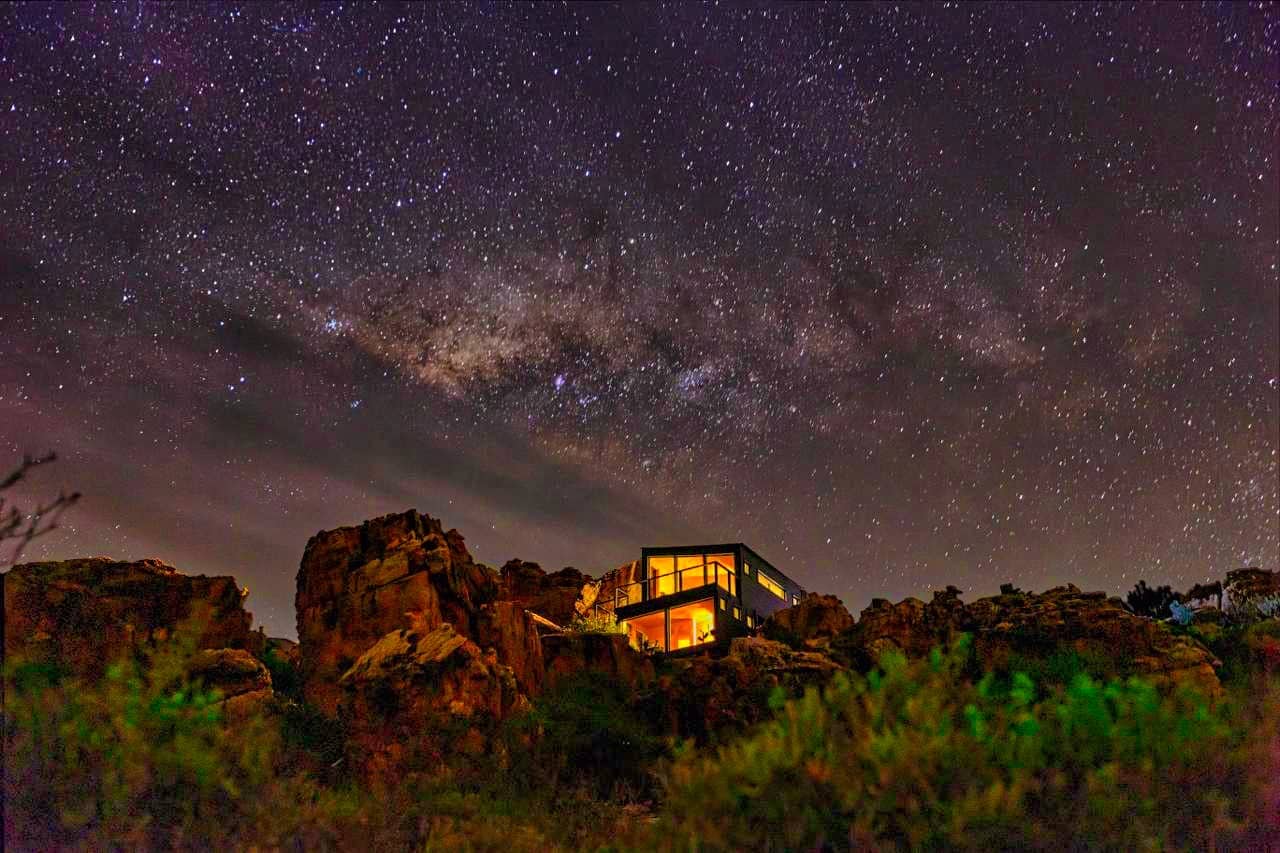
a lit chalet under the milky way in cederberg

You will not change your mindset by trying harder, which you have probably suspected for a while now. You have journaled about it. You have reframed it, more than once. You have thanked the universe for what you have until the thanking became one more thing on the list, and the loop is still running, that same low drone under the day.
Most mindset advice gives out right here. It takes for granted that effort is the thing missing, that you are stuck because you have not yet thought hard enough to think differently, and it never considers that the problem might sit somewhere other than your head. Somewhere like the fact that you have not properly looked up in months.
Go far enough out that the phone gives up and the sky comes back, and the Milky Way makes no attempt to move you. It is just there, a hundred thousand light years of it, supremely uninterested in your quarter. And you loosen anyway. The drone goes quiet, drowned out rather than switched off, which is a different thing, and some part of you seems to know the difference.
Awe, then. Not the shareable kind that lasts eleven seconds. The kind that turns up when you are standing under something too big to file and too old to care whether you file it.

Here is the mechanism, if you want one. Your brain does not take the world in so much as guess at it, over and over, from whatever it has seen before, so you are reacting less to the room than to your brain’s forecast of the room. Nothing much shifts while the forecast holds, and the forecast holds as long as the inputs do. Same desk, same commute, same four thoughts, and then the small private bafflement that everything has gone flat.
A dark sky is an input the forecast cannot place. It will not sit still in the model, so the model has to give, and it gives because the stars managed what your feed keeps failing at. They caught you off guard.
Better thoughts were never the problem. The input was.
You will feel this before you can account for it. Time goes loose. The running commentary drops its volume. Nothing gets solved, exactly, the same problems are waiting when you stand up, they have just stopped being the whole of the picture. This is where mindset actually moves, out under all of that, at a scale your desk cannot compete with, and once you are no longer the largest object in your own life you tend, quietly, to make better choices.
No amount of scrolling hands you that. Lying on your back in the dark for twenty minutes, watching the whole thing wheel over you, occasionally does.
It is less a practice than a place to put yourself.
Look up.

Reclaim Your Time

feet resting on the edge of the bathtub overlooking rocks in Cederberg

You close the laptop and cannot say where the day went. You’re tired, tired of being tired, and if someone asked what you actually did since breakfast you’d have to open your browser history to answer. Forty tabs. A half-written email. A comparison of two nearly identical kettles that you did not buy.

There was nothing dramatic or significant that took place. That’s the part I find hardest to accept. I could forgive a crisis. What happened instead is that the hours drained out through the small holes, too small to notice at the time, so I’ve started keeping an informal list of the holes, because they repeat.

Motion is the big one. The constant movement, switching between tasks, refreshing inbox driven by a belief that a person in motion must be getting somewhere. She looks busy. She feels busy. But if you stopped her mid-scroll and asked what she was building, she’d have nothing. I’ve tried this on myself at unflattering moments and the answer is genuinely nothing, there is no project the movement serves. The remedy I use is dull. One breath before opening the next thing, and the question of what matters most right now.

Then there are the wants that were installed. A decent portion of what you want on any given day came in through a feed: the machine noticed what held you, served more of it, and after enough repetitions the wanting felt like taste. I did not decide to care about a particular style of Japanese kitchen knife. I was taught to, over about six weeks, by a recommendation engine and I looked at it for 3 seconds too long. Now it is all I see, needless to say, I never wanted a Japanese knife. When you sit in a quiet place with the phone off and ask what you actually need today produces a very different list. It’s short. Sleep is usually on it. The knife never is.

The sunset one you know very well. Good light arrives over the ridge and the hand moves toward the phone before anything you could call a conscious thought occurred. I’m interested in what changes once the phone is out. You start composing. You are somewhere in the evening’s production department now rather than in the evening, and the strange proof is that you can photograph a sunset and afterwards have no memory of watching it. I’ve been trying to leave the phone in my pocket and let the things go unrecorded.

Add to the basket. Some purchases are barely about the item. You’re uneasy and the thing waiting at checkout carries a promise: of a slightly happier you. She’s calmer. Her cupboards make sense. The purchase never quite delivers so a few days later there’s a new basket with a new way to happiness. I’ve stopped trying to argue with the urge directly. What works is postponing it, closing the tab and walking out to do something with the hands, or calling a friend, and then checking whether the want is still there in the morning. Mostly it isn’t. The unease is, but the unease was never going to fit in a basket anyway.

The last one isn’t a leak. It’s the thing the leaks are for.

Five minutes of sitting still, phone in another room, doing nothing. I resisted writing this down because it sounds like advice, and worse, like the kind of advice printed on tote bags. When the noise stops, something comes up. The conversation you owe someone. A decision you’ve been feeding to busyness so you don’t have to make it.

All these simple things, help us to catch the leak while it’s leaking, name it. Then I decide what to do with it.

Make Decisions Right

man standing in shallow water at sunset

We tend to treat a big decision like an exam. Somewhere among the options there is one correct answer, and if we could only gather enough information we would find it, so we gather more, and ask more people, and run the scenarios again, and lie awake grading ourselves in advance. Choose well and the life that follows will be right. Choose badly and it won’t. That’s the model, anyway. I’m not sure anyone actually believes it in daylight, but at three in the morning it’s very convincing.

There’s a saying I come back to when I catch myself doing this: don’t try to make the right decision, make the decision right. For years I thought it was a motivational poster. What it’s really saying, though, is that most of a decision’s quality gets built after the deciding, not before, which changes where the effort should go.

What the research says
There’s decent evidence for this. In a well-known experiment, the psychologists Daniel Gilbert and Jane Ebert had photography students choose one of their own prints to keep. For half of them the choice was final. The other half were told they could come back and swap it later, and here’s the part I find funny: the students were sure the swap option would make no difference, and nearly all of them wanted it. It made a difference. The ones who could still change their minds ended up liking their print less than the ones who couldn’t. As long as the door stayed open, some part of them kept standing in it, comparing. The ones with no option just got on with liking what they had.

Another study followed graduates job-hunting. The ones set on finding the best possible job did find better jobs, with higher salaries, and felt worse about them than the people who had settled for good enough. Which is worth sitting with for a moment.

The farm
I know a bit about unpromising decisions. After twenty years of corporate career I chose a farm in the Cederberg with one cottage, no electricity, and forty minutes of dirt road before you reach a public one. Nobody weighing the options sensibly would have picked it, and I can’t honestly claim I knew something the spreadsheet didn’t. What I can say is that the decision wasn’t right on the day it was made. It got made right slowly, pipe by pipe and problem by problem, over that first year and every year since, and it is still being made right now, most weeks.

If you’re stuck
A few things help, in my experience. Write down the actual worst case, specifically, because fear prefers to stay vague and loses conviction when it has to commit to details. Check the options against your own values rather than against the best imaginable outcome, because in ten years the imaginary best will be gone and the values will still be there. And go easy on yourself, since you will sometimes choose wrong. Everyone does. The only reliable way to avoid it is to choose nothing, and that has costs too, usually larger and quieter.

The uncertainty doesn’t go away whichever you pick.

Moving at a Human Pace

a person wearing black clothes walking in the white landscape

The first three months of the year went quickly, and what I remember of them is mostly small. Making cacao in the early dark. Sitting. Walking the dogs. Swimming in the river on the days the heat made the decision for me. Those were the anchors, and around them, the retreat.
People imagine that running a retreat is calm work, and some days it is. Most days it is an ordinary business in an extraordinary place: rooms to prepare, questions to answer, ten guests arriving with different needs and different weather in them, the practical and the human taking turns at the front of the queue. A morning can begin in complete stillness and be a frenzy by ten. The place doesn’t produce the pace. I do, and that is the uncomfortable, useful part.

The empty boat
There is a story from Zhuangzi that I keep coming back to. A man is crossing a river when another boat knocks into his. He wheels around, ready to shout at the other rower, and sees the boat is empty. It has simply drifted loose. The collision is identical either way, but the anger has nobody to land on, so it dissolves, and the man is left looking at what the anger actually was: something he brought to the bump, not something the bump contained.

Most of the collisions in a working day are empty boats. The interruption, the delay, the thing not done the way I would have done it. When the frenzy starts, I try to ask whether anyone is actually rowing at me. Usually not.
So I keep choosing the slower speed, on purpose, in a world that treats speed as the default proof of seriousness. It is the same premise the whole place runs on, and the same one Rest & Thrive hands to guests: that walking pace is not a lapse from real life but roughly the speed at which a life can be noticed.

The Double Standard of Ageing

Daria Rasmussen laughing in the garden

The societal pressure to look like you’re 25 when you’re actually 50 is ridiculous. As if we are supposed to perform acts of self-aggression just to feel worthy. I have been watching women around me do this for years, and doing some of it myself, and the longer I watch the stranger it looks.

The double standard has a name
Susan Sontag named it in 1972, in an essay called The Double Standard of Ageing, and half a century later it reads like reporting. Men, she observed, are permitted to age into distinction; the same years that make a man look weathered make a woman look like she has failed at something. Ageing, for women, is treated less as a phase of life than as a lapse in discipline. It simply gets enforced, daily, by a thousand small verdicts, and by now most of the enforcement is internal.

The war economy
Notice the language the beauty industry reaches for: fight the signs of ageing, defy your age, turn back the clock. It is the vocabulary of war, and wars are profitable for exactly one side. The industry manufactures the fear, then sells the armistice, cream by cream, and the arrangement only works if you can be made to see your own face as the enemy. Meanwhile the faces we compare ourselves against have been retouched into physical impossibility. You know it and I know it, and the comparison wounds anyway.
The costs are not only financial. The maintenance of an impossible face and body runs through punishing diets, compulsive exercise, procedures. Self-inflicted, all of it, and each round reinforces the premise underneath: that ageing is a catastrophe to be delayed rather than a life continuing to happen.

The story gets into the body
Here is where it stops being a matter of taste. In 2002, Becca Levy and colleagues at Yale published a study following 660 adults over as much as 23 years. The people who held more positive perceptions of their own ageing lived, on average, 7.5 years longer than those who held negative ones, and the gap held after accounting for age, health, loneliness and income. It is one study, though its direction echoes across the field. Sit with the inversion it suggests. The industry says fight ageing in order to live well. The evidence, inconveniently, points the other way: the fight itself may be the corrosive part.

Counting differently
Anaïs Nin wrote in her diaries that we do not grow chronologically at all, but unevenly, in one dimension and not another, ripening in patches. That has always struck me as the honest description. A face records the same uneven growing. The lines mark where a life actually happened, which seems a strange thing to spend money erasing.

Questions like these, what a woman’s age is actually for, what gets possible once the performance stops, are the territory Unmade, the women’s retreat, explores.

The Psychology of Awe

a couple watching a full moon

Awe is what happens when you meet something too large for your existing categories. The psychologists Dacher Keltner and Jonathan Haidt, who gave the emotion its modern research definition, put it in two parts: a perception of vastness, and a need for accommodation, meaning the mind has to rearrange itself to fit what it is looking at. The vastness can be physical, a mountain range, a night sky, or conceptual, an idea, a piece of music, someone else’s courage. 

I remember the first time it happened to me properly. As a teenager I looked up at a truly dark night sky and the stars were so bright and numerous that they filled the whole of it, a world far beyond our own. I felt small and significant at the same time, in the best possible way, and I have been chasing an explanation for that combination ever since.

What the research finds
The research explains more of it than I expected. The signature effect of awe is what the literature calls the small self: attention shifts away from your own concerns toward the larger thing you are part of, and the shift is measurable. In a series of five studies published in 2015, people who experienced awe, including participants who simply stood for one minute in a grove of towering eucalyptus trees, went on to behave more generously and helpfully than controls. Awe, it turns out, is a social emotion triggered mostly by unsocial things.
It also does something odd to time. Experiments by Rudd, Vohs and Aaker found that people induced to feel awe perceived time as more expansive, felt less impatient, and reported greater life satisfaction, all from a brief exposure. The everyday feeling of having no time is partly a feeling of having no scale, and awe restores the scale.

Where to find it
The reliable source is nature at magnitude, but it is not the only one. The research catalogues awe arriving through music, through ideas, and notably through what Keltner calls moral beauty, the witnessed goodness or courage of other people, which turns out to be one of the most common triggers of all. And there is the version Carl Sagan pointed at when he wrote that we are a way for the cosmos to know itself: the awe of understanding your own position in something incomprehensibly old.

It is why we built Bliss & Stars here, under one of the darkest skies in the country, and it is what we watch arrive in guests, usually without warning, somewhere between the boulders and the stars. Sometimes there are tears or deep sights, and occasional swear word.  Awe does that, and nobody is embarrassed by it out here.

However, you do not need to come here to experience that feeling. Awe is cheaper than its reputation. It asks only for something larger than you and a moment of actually looking, and at least one of those is overhead every clear night.

How to Deal with A Crisis

word Crisis on a black board

Now and then, when things fall apart, I experience a mixture of fear and frustration. I desperately try to fix the situation, worrying, running through multiple what-if scenarios in my head. This can go on for days before I manage to stop and taste my own medicine: accept what is beyond my control, let go of the what-ifs, and admit that I do not know what the future holds. None of it comes naturally to me. I suspect it comes naturally to almost nobody.


What a crisis actually is
The word has a more interesting history than its current usage suggests. In Greek, krisis meant decision, or judgement, the point at which things separate one way or the other. Hippocratic physicians used it for the moment in an illness when the patient would either start to recover or start to decline. So a crisis was originally a turning point, and only later became shorthand for catastrophe.
Psychologically, what marks a crisis is loss. Sometimes the loss is concrete: a person, a job, health. Sometimes it is harder to point at, a loss of direction or of meaning, and those can be every bit as disorienting. In each case something that felt certain has stopped being certain, and the sense of control has gone with it.


The four phases
The Swedish psychiatrist Johan Cullberg described a course that most crises tend to follow. First comes shock, lasting hours or days, and often strangely unreal, as though the event were happening slightly to one side of you. The reaction phase follows, and this is when the defences arrive: denial, guilt, blame, the endless replaying of how it might have been avoided. Processing is the long, unglamorous middle, where the loss gradually becomes fact. Eventually the world turns usable again, which Cullberg called reorientation. Not the same world as before, but a usable one.
He was careful to say the phases are not tidy. People circle back, or skip one, or stall. Some get stuck, often somewhere between reaction and processing, and that is the point at which finding support belongs near the top of the to-do list. Nobody processes a serious loss on willpower alone.
Why we make it harder
We have become so fixated on happiness that we can hardly bear grief, loss or pain at all. Pain gets treated as a malfunction to correct quickly, when often it is a phase that has to be moved through at its own speed. And when direction goes missing, the automatic reaction for most of us is to act our way out of it, or think our way out of it, immediately, because being in a state of not knowing is so uncomfortable.
There is an old Buddhist simile about this. Pain is the first arrow. Everything we pile on top by fighting the fact of the pain, the resentment, the resistance, is a second arrow, and that one we fire ourselves. It is not easy, but I promise, you double the suffering when you keep resisting something that already is and sits outside your control.


What acceptance means here
People bristle at the word acceptance because it sounds like approving of what happened, or giving up. It means something closer to accurate mapping. Let the situation be what it already is, so that whatever energy remains can go toward the part that can still move. Release the version of events that should have happened, since a surprising amount of the hurt lives in that version. The uncertainty stays regardless of what you do with it.


Some crises are specifically about work, and about the self that work built. Burnout Rewire sits in that particular territory.