
Stargazing in South Africa: A Night in the Cederberg

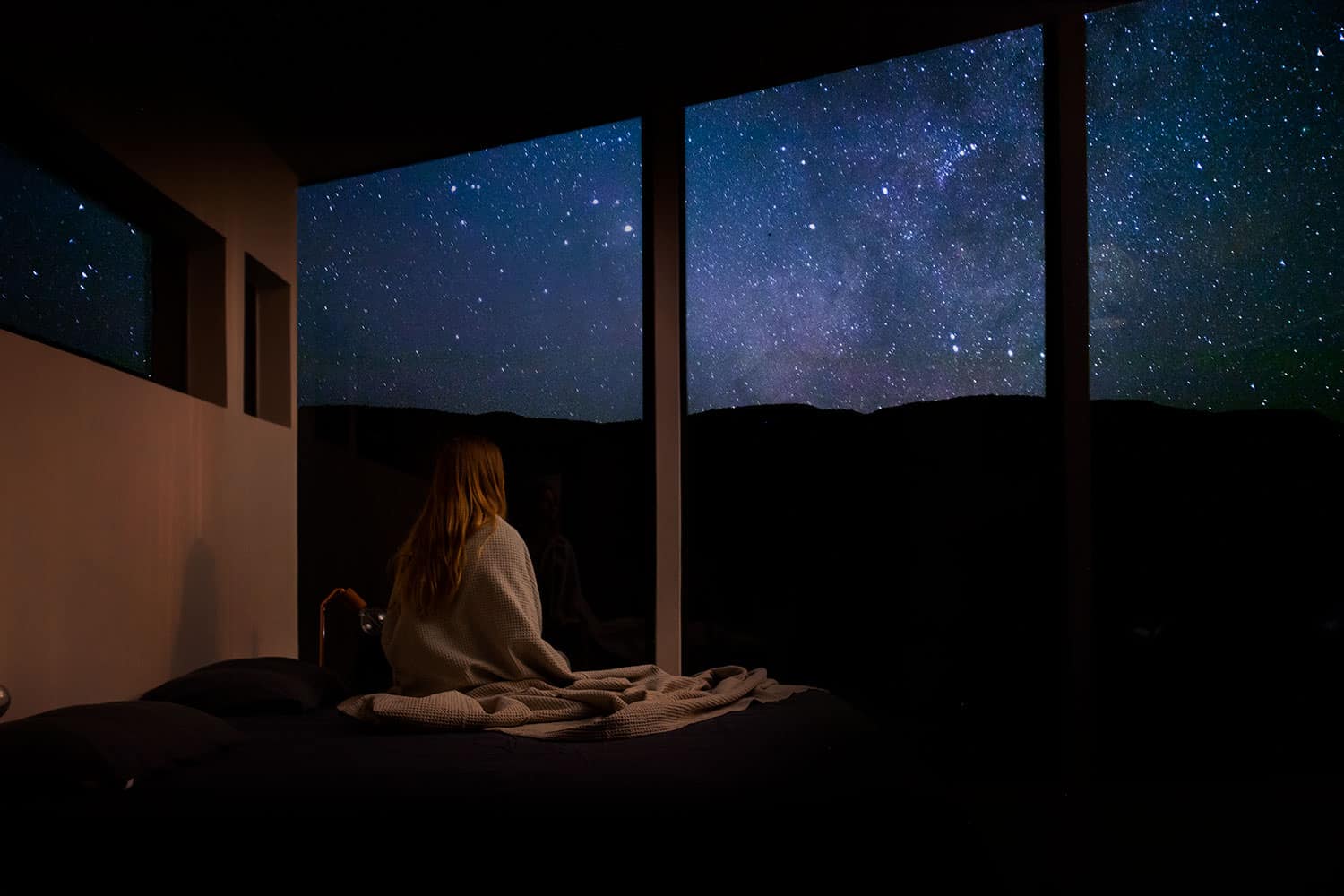
milky way over bliss and stars in south africa

The Cederberg has some of the darkest skies in South Africa, being far away from any city light pollution. It is one of the few places left in the world where the night sky still arrives in full, and that has less to do with atmosphere in the romantic sense than with geography, altitude, and the near-total absence of artificial light in every direction.
Most people have never really seen the night sky. They have seen a version of it, thinned out by the orange glow that sits over every city, where a few dozen of the brightest stars survive and the rest are gone. The actual sky, the one with an abundance of stars and a galaxy running through the middle of it, is a different object entirely, and you have to drive a long way from a streetlight to find it.

Why the Cederberg sky is this dark
Darkness, for an astronomer, is measured. The Bortle scale runs from one to nine, where one is the darkest sky left on Earth and nine is a city centre where you can count the visible stars on two hands. Most people live their whole lives somewhere between seven and nine. The Cederberg sits at the other end. Parts of the area reach class one, the rating given to the emptiest deserts, because there is almost nothing out here to make light. There is no town close by to throw a glow on the horizon.
The air plays a huge role too. The Cederberg is high and dry, and the region holds roughly 250 clear nights a year. Dry air carries less haze. Less haze means more stars, and sharper ones.

What you can actually see
The first thing you notice on a moonless night is the Milky Way, not as a faint smudge but as a band with a bright, mottled core and dark lanes cutting across it. That core is the centre of our own galaxy, in the direction of Sagittarius and Scorpius, and from the southern hemisphere it climbs high overhead rather than skulking near the horizon the way it does up north.
Then the things you can only see from down here. Two faint patches off to one side, the Large and Small Magellanic Clouds, are whole satellite galaxies, invisible from all of Europe and most of North America. Omega Centauri, the brightest globular cluster in the sky, sits as a fuzzy star to the naked eye and resolves into several hundred thousand suns through a telescope. Beside the Southern Cross there is a hole in the Milky Way called the Coalsack, a cloud of dust thick enough to block the stars behind it.
Through any decent telescope the views widen. Saturn’s rings hold up at almost any magnification and tend to make people laugh out loud the first time. Jupiter shows its four largest moons strung out in a line that has shifted by the next night. In the southern summer there is the Orion Nebula, a star nursery you can catch as a smudge with your eyes and as a lit cloud with glass in front of them.
You do not need your own equipment to see most of this. A pair of binoculars and a blanket you can lay on will already show you more than a lifetime of city sky has.

Best time of year to come
There is no single best month. It depends on what you want to see.
The Milky Way’s bright core is a winter object in the southern hemisphere. It stands high and full after dark, and the band is at its most obvious from roughly May to September. That is the time to come for the version of the sky most people picture when they picture this.
Orion is a summer object here. He hangs in the evening sky with his belt and his nebula from November to February. The Magellanic Clouds ride high through those same months.
Whatever the season, the moon has more impact on stargazing than the month does. A full moon washes out everything faint while the river and the rocks are lit bright. Plan the trip around new moon and the difference is huge. The sky you get on a dark night is a different sky from the one you get a fortnight later.

Letting your eyes adjust, and what to bring
The single thing that separates a good night under this sky from a forgettable one is patience with your own eyes. Dark adaptation takes time. The first few minutes outside show you almost nothing beyond the brightest stars, and then over the next twenty to thirty minutes the fainter ones arrive in their thousands, the Milky Way fills in, and the sky you were promised finally turns up. One glance at a phone screen, or a car’s interior light when someone opens a door, undoes most of it in a second and costs you another twenty minutes to win back. If you need light, make it red. A head torch with a red setting lets you find a flask or a chair without blinding everyone around you.
Beyond that, the kit is short. Warm layers, more than you think you need, because the Cederberg drops cold after dark in every season and the cold is what sends most people indoors before the good part. Something to lie back on, since the best of the sky is straight up and your neck will not forgive an hour spent craned at it. A pair of binoculars does more than people expect: a basic 10×50 pair pulls in the craters on the moon, the moons of Jupiter, the larger star clusters, and turns the Magellanic Clouds from smudges into texture. A flask of something hot. A star chart, or a phone app left on its red night mode and in aeroplane mode so the screen stays dim and nothing buzzes. After that it is mostly a matter of staying out longer than you planned to.

Common questions
When is the best time to stargaze in the Cederberg?
Any clear night around new moon. Come between May and September for the Milky Way’s core. For Orion and the Magellanic Clouds, come between November and February. In any season, avoid the nights either side of a full moon.

Can you see the Milky Way without a telescope?
Yes. On a moonless night the band is visible to the naked eye, core and dark lanes included. A telescope adds the planets, the clusters and the nebulae.

Do you need to know anything about astronomy?
No. The brightest things, the Milky Way, the Magellanic Clouds, the Southern Cross, are obvious once your eyes adjust and the sky is dark enough.

Do you need to book a retreat to stargaze in the Cederberg?
No. Stargazing here asks for nothing but a clear, moonless night and somewhere dark to stand. If you would rather take it in through the retreat’s 20-inch telescope, with the resident chefs cooking cosmic dinner  that is what Orion’s Odyssey at Bliss & Stars is for.
How Awe and the Night Sky Can Shift Your Mindset Instantly

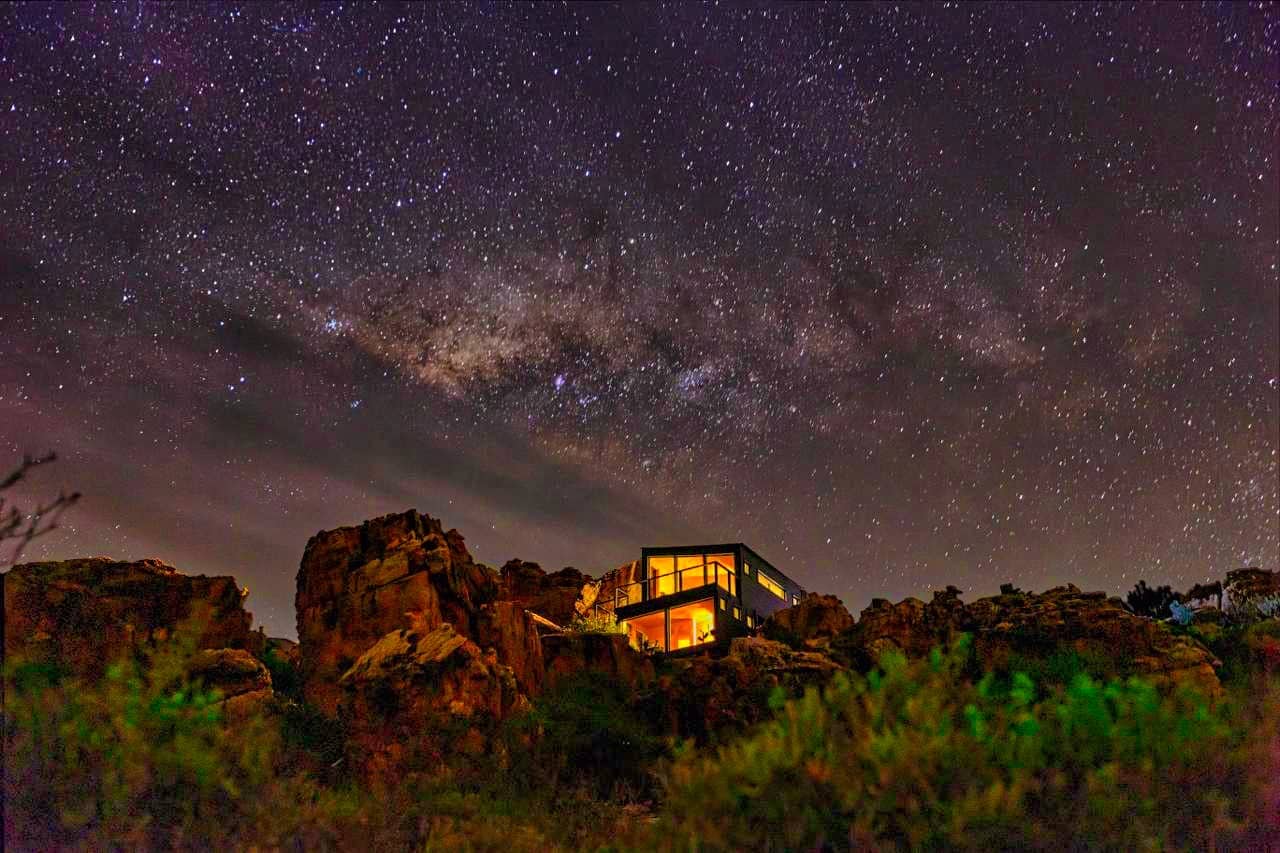
a lit chalet under the milky way in cederberg

You will not change your mindset by trying harder, which you have probably suspected for a while now. You have journaled about it. You have reframed it, more than once. You have thanked the universe for what you have until the thanking became one more thing on the list, and the loop is still running, that same low drone under the day.
Most mindset advice gives out right here. It takes for granted that effort is the thing missing, that you are stuck because you have not yet thought hard enough to think differently, and it never considers that the problem might sit somewhere other than your head. Somewhere like the fact that you have not properly looked up in months.
Go far enough out that the phone gives up and the sky comes back, and the Milky Way makes no attempt to move you. It is just there, a hundred thousand light years of it, supremely uninterested in your quarter. And you loosen anyway. The drone goes quiet, drowned out rather than switched off, which is a different thing, and some part of you seems to know the difference.
Awe, then. Not the shareable kind that lasts eleven seconds. The kind that turns up when you are standing under something too big to file and too old to care whether you file it.

Here is the mechanism, if you want one. Your brain does not take the world in so much as guess at it, over and over, from whatever it has seen before, so you are reacting less to the room than to your brain’s forecast of the room. Nothing much shifts while the forecast holds, and the forecast holds as long as the inputs do. Same desk, same commute, same four thoughts, and then the small private bafflement that everything has gone flat.
A dark sky is an input the forecast cannot place. It will not sit still in the model, so the model has to give, and it gives because the stars managed what your feed keeps failing at. They caught you off guard.
Better thoughts were never the problem. The input was.
You will feel this before you can account for it. Time goes loose. The running commentary drops its volume. Nothing gets solved, exactly, the same problems are waiting when you stand up, they have just stopped being the whole of the picture. This is where mindset actually moves, out under all of that, at a scale your desk cannot compete with, and once you are no longer the largest object in your own life you tend, quietly, to make better choices.
No amount of scrolling hands you that. Lying on your back in the dark for twenty minutes, watching the whole thing wheel over you, occasionally does.
It is less a practice than a place to put yourself.
Look up.

A Stargazing Evening in the Cederberg

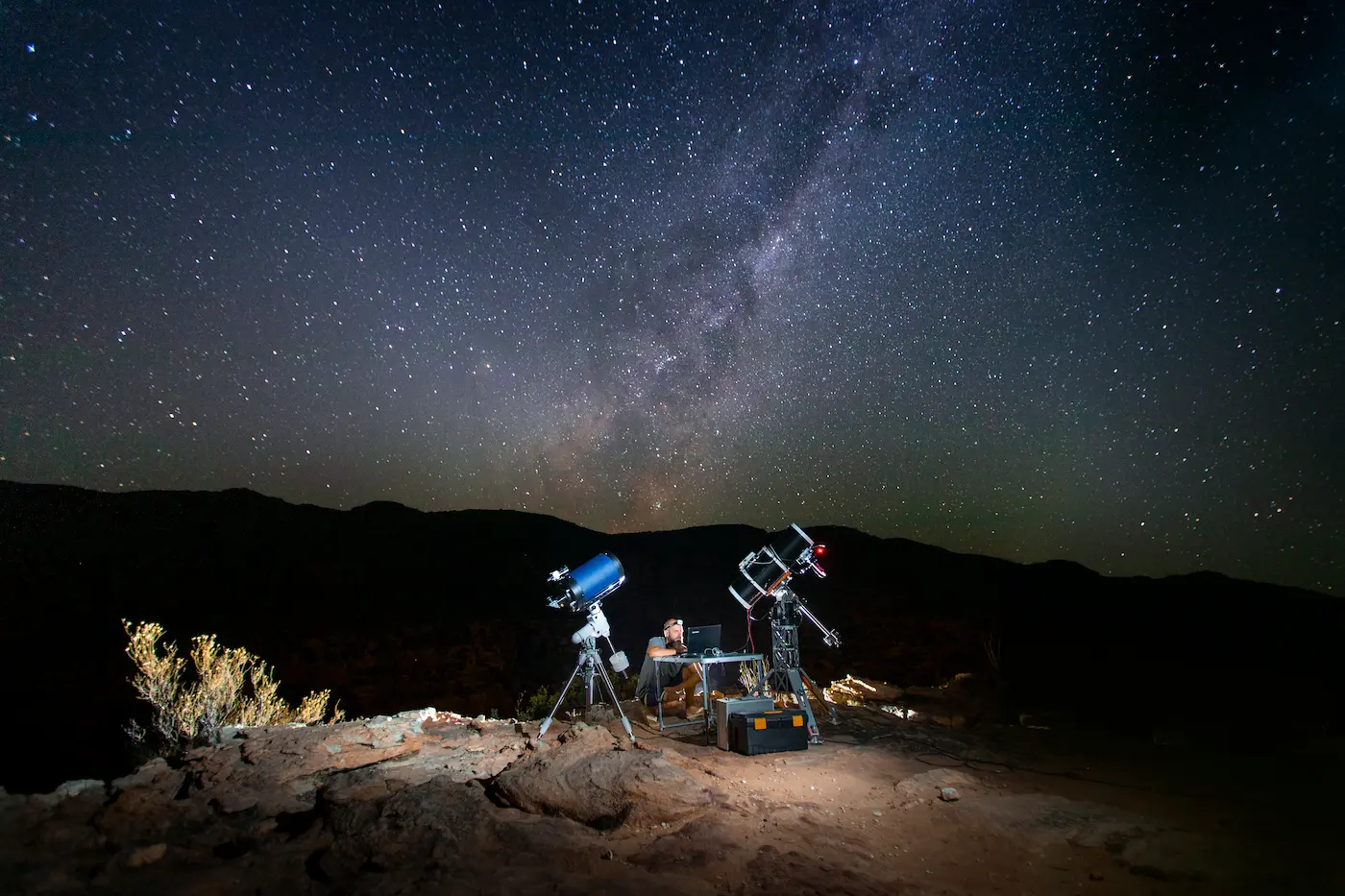
Astronomy equipment and telescopes set up under the Milky Way at Bliss and Stars off-grid retreat, Cederberg Mountains, South Africa

The stargazing evenings here belong to Heine. He runs the retreat with me, and before that his background was in astrophysics, which makes him an unusual kind of guide: someone who can point a 20-inch telescope at a nebula and also explain, in plain words, why any of it should matter to the person shivering happily next to it.

The evening starts after dinner, when the last lights go off and the dark does what Cederberg dark does. Then Heine starts talking, and the first thing he usually asks people to take seriously is the oldest fact in the sky: the light arriving in your eye has been travelling for years, sometimes for millions of them, so looking up is looking back.

From there he goes somewhere most stargazing evenings don’t. The iron in your blood and the calcium in your bones were made inside stars, in the collapse and explosion of suns that died before ours was born. This is not poetry, or rather it is poetry that happens to be settled physics. Every guest has heard some version of “we are stardust” before. Hearing it under an actual sky, from someone who can walk you through the mechanism, is different, and you can watch it land.

What he avoids is jargon. Black holes, stellar fusion, the expansion of space all come up, but as stories rather than terminology, and he ties them back to the older stories too, the ones people told about this same sky long before telescopes. The point is not to leave guests with facts. It is to change what the sky is to them. People arrive seeing scattered lights. They tend to walk back to their chalets seeing something more like a family history.

There are usually questions. The questions are often better than the ones asked at any lecture, I think because the sky is right there while you ask.

If you want an evening like this, with the telescope and several nights to work with, that is Orion’s Odyssey. Bring warm clothes. The universe is worth a cold neck.

The Power of the Night Sky: How Astronomy Inspires Wonder and Well-Being

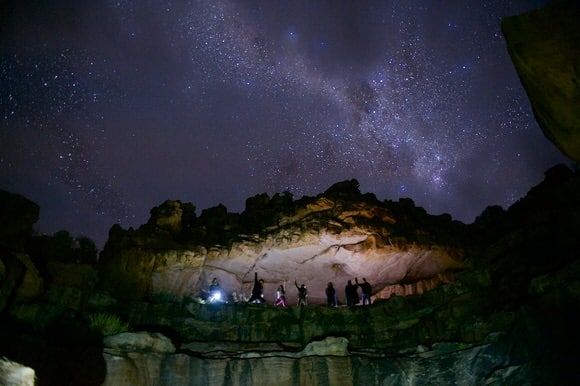
connecting with others through stargazing at bliss & stars

Every bit of light that reaches your eye from the night sky is old. Moonlight is about a second old. Sunlight, though you shouldn’t check directly, left eight minutes ago. The light of Alpha Centauri, the nearer of the two bright pointers beside the Southern Cross, has been travelling for a bit over four years. And on a properly dark night in the southern hemisphere you can see, without any equipment, two soft smudges that most of the world’s population never sees at all: the Magellanic Clouds, two small companion galaxies. Their light set out more than 160,000 years ago, when our species was young and nobody had left Africa yet. So the sky you look at is really the past, layers of it, all arriving at the same time.

I find this impacts us in a way that almost nothing else does. The daily concerns don’t disappear, but they change size, and I think that is where the benefit lives.

What the perspective does

Carl Sagan built a whole argument on one photograph, the pale blue dot image Voyager 1 took of Earth from six billion kilometres away. In it, the planet is a fraction of a pixel. His point was not that we are insignificant. It was that the frame we normally judge our lives in is far too tight. Widening it, even for half an hour on a blanket, tends to calm whatever felt urgent at dinner.

The research on why this works sits under the psychology of awe, which we’ve written about separately. The short version: vastness reliably shrinks self-focus, and that shrinking is measurably good for us. The night sky happens to be the largest vast thing available, and the only one that comes back every night for free.

How to actually do it

You don’t need a telescope. For this kind of looking the naked eye is the right instrument, and the requirements are mostly things to avoid: no city glow, no full moon, no phone for the first twenty minutes while your eyes adjust to the dark. Learn a few anchors so the sky has some structure for you, the Southern Cross and its pointers, Scorpius in winter, the Clouds themselves. An app can identify the rest, though I’d wait a while before reaching for it. Lie down if you can, because your neck will complain long before you are done looking. Afterwards, maybe write a line or two about it. The feeling fades faster than you’d expect, and a sentence keeps some of it.

If you want the full-strength version, that is more or less what Orion’s Odyssey is: four nights under Cederberg darkness, with a 20-inch telescope for the things the naked eye can’t reach. But the ordinary version is available tonight, wherever the lights thin out, and it needs nothing more than a blanket and some patience.

The sky offers us the wider view, night after night, whether or not anyone steps outside to take it.

Meteor Showers in South Africa

Stargazing Blissandstars photo by teagan cunniffe

A Guide to Meteor Showers in South Africa
Standing still is an illusion of scale. The ground under you is moving around the sun at roughly 107,000 kilometres an hour, and it never travels the same road twice without consequences. Comets are untidy travellers. They shed dust as they go, and the dust stays out there, strung along the orbit like litter on a highway. A meteor shower is what it looks like from the ground when the planet drives through it. We are all travellers. Most of the year we simply cannot see the road.

What a shooting star actually is
Almost nothing, which is the surprising part. A typical meteor is a fleck of comet dust smaller than a grain of rice, hitting the upper atmosphere at tens of kilometres per second and burning out in under a second, roughly 80 to 100 kilometres above your head. Nothing falls. Nothing lands. What you see is friction, briefly, at the edge of space.
Because the dust trails sit in fixed orbits, Earth crosses each one at the same point in its lap every year. That is why meteor showers keep a calendar, and why they are named for the constellation the streaks appear to radiate from.

Which meteor showers are visible from South Africa
The famous Perseids of every northern-hemisphere August barely clear the horizon here, which the international coverage rarely mentions. The south keeps its own calendar, and it is a good one. The Eta Aquariids arrive in early May, debris from Halley’s Comet, and favour southern skies in particular. The Southern Delta Aquariids follow in late July. The Orionids in October are Halley’s dust met from the other side of its orbit. And the Geminids in mid-December are the most generous shower of the year, capable of producing upward of a hundred meteors an hour under genuinely dark skies. The Geminids are also the odd ones out: their parent is not a comet but an asteroid, 3200 Phaethon, still shedding after all these laps.

How to watch
A telescope is the one thing you should not bring. Meteors cross wide stretches of sky and the naked eye is the correct instrument. What matters instead is darkness, and this is where most attempts fail: from a lit suburb, a hundred-an-hour shower dwindles to a handful. Get somewhere genuinely dark, go after midnight when your side of the planet faces into the oncoming dust, avoid the full moon, and give your eyes twenty minutes to adjust. Then lie back and wait. Winter Geminids reward blankets.

The Cederberg’s skies are among the darkest in the country, which is why Bliss & Stars sits under them and why Orion’s Odyssey is spent mostly looking up. But a shower asks for nothing except darkness and patience.
Each streak is the planet meeting something it left behind on an earlier lap. Nothing up there is falling. Everything, including the ground you are lying on, is in motion.

The Loss of Darkness

Bliss and Stars retreat cottage nestled in Cederberg boulders under the Milky Way, South Africa

An estimated 83 per cent of the world’s population now lives under light-polluted skies, and roughly a third of humanity can no longer see the Milky Way from where they stand. Those figures come from the world atlas of artificial night sky brightness, published in 2016, and the picture has worsened since. Citizen science measurements published in Science in 2023 found the night sky brightening by nearly ten per cent a year. At that rate, a child born in a place where 250 stars are visible will see only about 100 of them by their eighteenth birthday.

The loss is quiet. Nobody notices the stars going out, because they go out one at a time, and because the light doing it is the light we asked for.

How light pollution affects sleep and health

The body reads light as instruction. Artificial light at night suppresses melatonin and unsettles the circadian rhythm that most of our physiology runs on, and the research links that disruption to poorer sleep, low mood and a longer list of physical conditions than is comfortable to read. For most of evolutionary history, darkness arrived on schedule every night. The body still expects it, and increasingly does not get it.

What the night loses besides stars

Wildlife has no blackout curtains. Sea turtle hatchlings follow the brightest horizon, which for millions of years was the sea and is now often the car park behind the beach. Migrating birds navigate by stars and collide with lit buildings by the hundreds of millions each year. Nocturnal insects, already in decline, spiral around streetlights instead of pollinating and feeding the food chain that depends on them.

There is also the plain arithmetic. A large share of outdoor lighting shines sideways or upward, illuminating the underside of clouds at considerable expense. Whatever else darkness is, it is cheaper.

Where darkness remains

There are still places the atlas colours black. The Cederberg is one of them, a corridor of genuinely dark sky three hours north of Cape Town, and the people who lived here longest read that sky closely. In |Xam accounts recorded in the nineteenth century, a girl of the Early Race threw wood ash into the sky so that people could see their way home at night, and the ash became the Milky Way. 

That darkness is the reason Bliss & Stars points a 20-inch telescope at it, and the reason Orion’s Odyssey is built around four nights of it. No equipment is needed for most of it. On the darkest moonless nights, the Milky Way is bright enough to cast a faint shadow.

Unlike most environmental damage, this kind reverses instantly. The dark is still there, behind the light. It comes back the moment the lights go off.