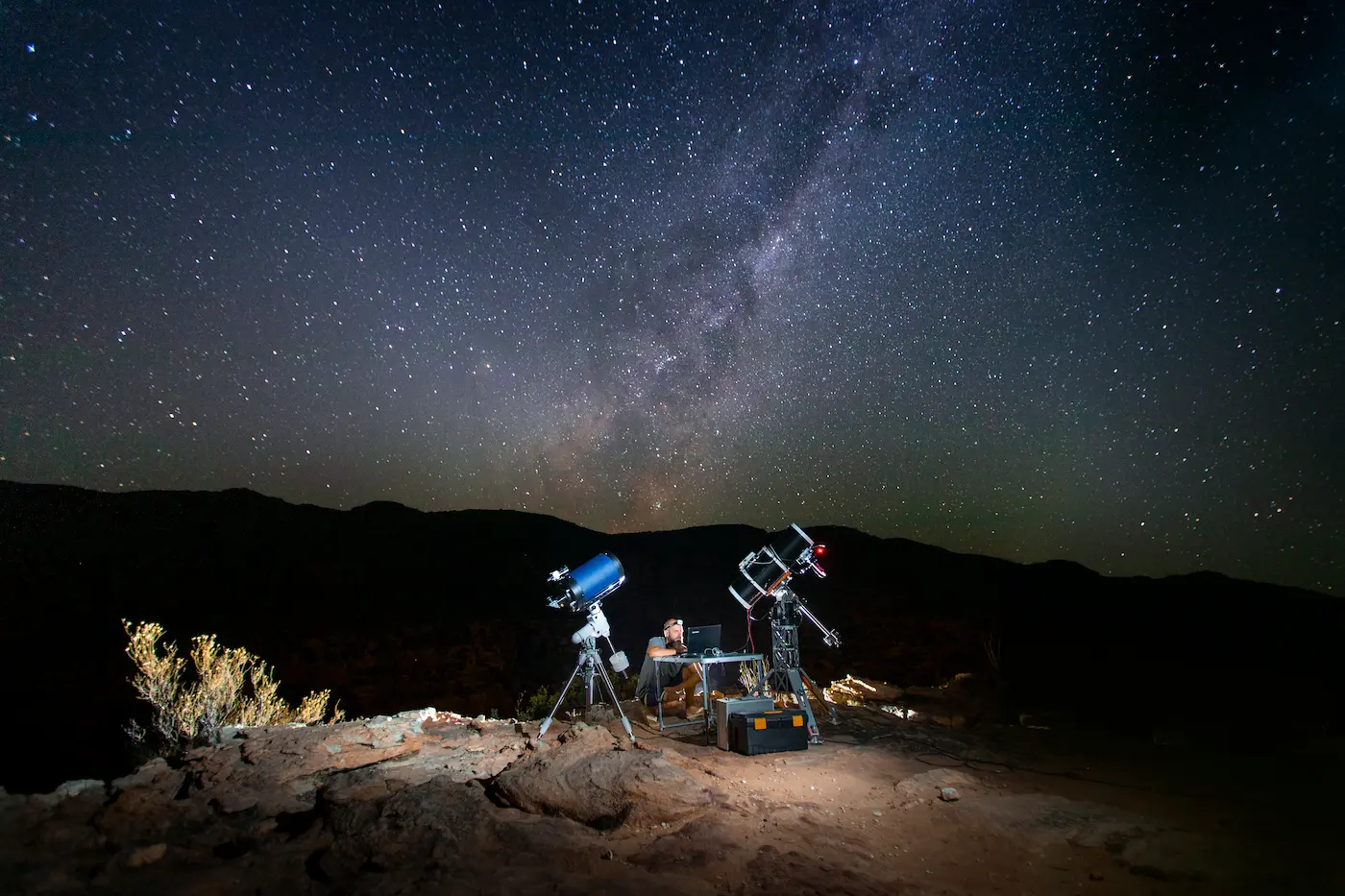
The stargazing evenings here belong to Heine. He runs the retreat with me, and before that his background was in astrophysics, which makes him an unusual kind of guide: someone who can point a 20-inch telescope at a nebula and also explain, in plain words, why any of it should matter to the person shivering happily next to it.
The evening starts after dinner, when the last lights go off and the dark does what Cederberg dark does. Then Heine starts talking, and the first thing he usually asks people to take seriously is the oldest fact in the sky: the light arriving in your eye has been travelling for years, sometimes for millions of them, so looking up is looking back.
From there he goes somewhere most stargazing evenings don’t. The iron in your blood and the calcium in your bones were made inside stars, in the collapse and explosion of suns that died before ours was born. This is not poetry, or rather it is poetry that happens to be settled physics. Every guest has heard some version of “we are stardust” before. Hearing it under an actual sky, from someone who can walk you through the mechanism, is different, and you can watch it land.
What he avoids is jargon. Black holes, stellar fusion, the expansion of space all come up, but as stories rather than terminology, and he ties them back to the older stories too, the ones people told about this same sky long before telescopes. The point is not to leave guests with facts. It is to change what the sky is to them. People arrive seeing scattered lights. They tend to walk back to their chalets seeing something more like a family history.
There are usually questions. The questions are often better than the ones asked at any lecture, I think because the sky is right there while you ask.
If you want an evening like this, with the telescope and several nights to work with, that is Orion’s Odyssey. Bring warm clothes. The universe is worth a cold neck.