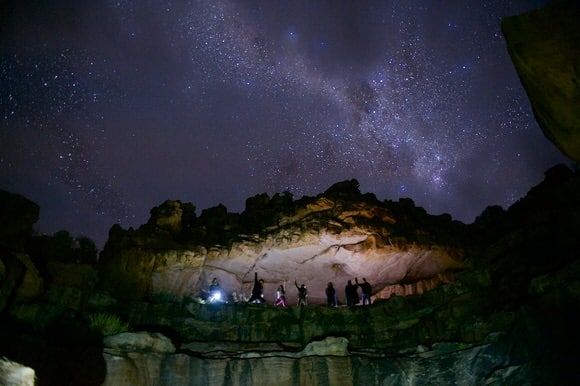
Every bit of light that reaches your eye from the night sky is old. Moonlight is about a second old. Sunlight, though you shouldn’t check directly, left eight minutes ago. The light of Alpha Centauri, the nearer of the two bright pointers beside the Southern Cross, has been travelling for a bit over four years. And on a properly dark night in the southern hemisphere you can see, without any equipment, two soft smudges that most of the world’s population never sees at all: the Magellanic Clouds, two small companion galaxies. Their light set out more than 160,000 years ago, when our species was young and nobody had left Africa yet. So the sky you look at is really the past, layers of it, all arriving at the same time.
I find this impacts us in a way that almost nothing else does. The daily concerns don’t disappear, but they change size, and I think that is where the benefit lives.
What the perspective does
Carl Sagan built a whole argument on one photograph, the pale blue dot image Voyager 1 took of Earth from six billion kilometres away. In it, the planet is a fraction of a pixel. His point was not that we are insignificant. It was that the frame we normally judge our lives in is far too tight. Widening it, even for half an hour on a blanket, tends to calm whatever felt urgent at dinner.
The research on why this works sits under the psychology of awe, which we’ve written about separately. The short version: vastness reliably shrinks self-focus, and that shrinking is measurably good for us. The night sky happens to be the largest vast thing available, and the only one that comes back every night for free.
How to actually do it
You don’t need a telescope. For this kind of looking the naked eye is the right instrument, and the requirements are mostly things to avoid: no city glow, no full moon, no phone for the first twenty minutes while your eyes adjust to the dark. Learn a few anchors so the sky has some structure for you, the Southern Cross and its pointers, Scorpius in winter, the Clouds themselves. An app can identify the rest, though I’d wait a while before reaching for it. Lie down if you can, because your neck will complain long before you are done looking. Afterwards, maybe write a line or two about it. The feeling fades faster than you’d expect, and a sentence keeps some of it.
If you want the full-strength version, that is more or less what Orion’s Odyssey is: four nights under Cederberg darkness, with a 20-inch telescope for the things the naked eye can’t reach. But the ordinary version is available tonight, wherever the lights thin out, and it needs nothing more than a blanket and some patience.
The sky offers us the wider view, night after night, whether or not anyone steps outside to take it.