
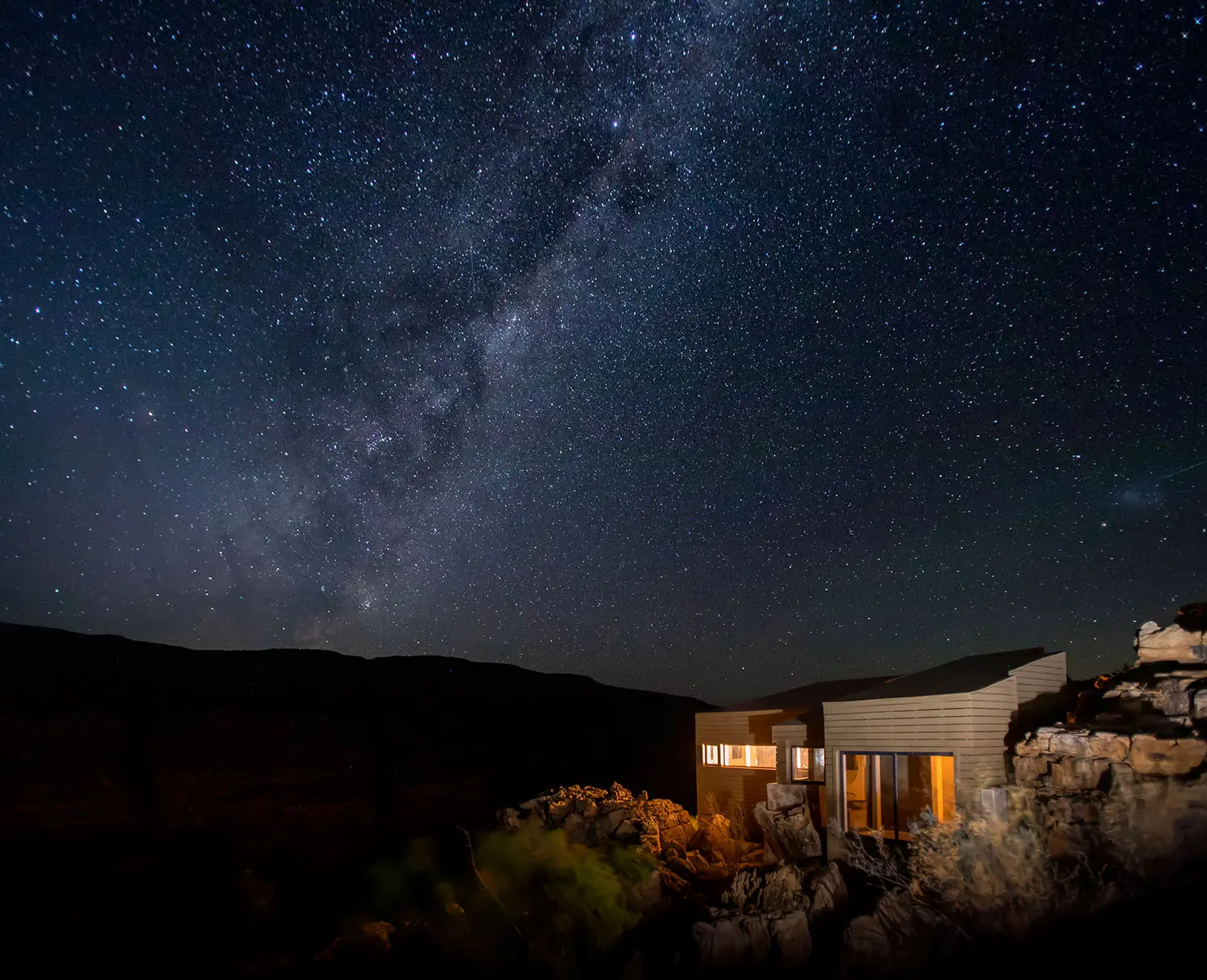
The Cederberg has some of the darkest skies in South Africa, being far away from any city light pollution. It is one of the few places left in the world where the night sky still arrives in full, and that has less to do with atmosphere in the romantic sense than with geography, altitude, and the near-total absence of artificial light in every direction.
Most people have never really seen the night sky. They have seen a version of it, thinned out by the orange glow that sits over every city, where a few dozen of the brightest stars survive and the rest are gone. The actual sky, the one with an abundance of stars and a galaxy running through the middle of it, is a different object entirely, and you have to drive a long way from a streetlight to find it.
Why the Cederberg sky is this dark
Darkness, for an astronomer, is measured. The Bortle scale runs from one to nine, where one is the darkest sky left on Earth and nine is a city centre where you can count the visible stars on two hands. Most people live their whole lives somewhere between seven and nine. The Cederberg sits at the other end. Parts of the area reach class one, the rating given to the emptiest deserts, because there is almost nothing out here to make light. There is no town close by to throw a glow on the horizon.
The air plays a huge role too. The Cederberg is high and dry, and the region holds roughly 250 clear nights a year. Dry air carries less haze. Less haze means more stars, and sharper ones.
What you can actually see
The first thing you notice on a moonless night is the Milky Way, not as a faint smudge but as a band with a bright, mottled core and dark lanes cutting across it. That core is the centre of our own galaxy, in the direction of Sagittarius and Scorpius, and from the southern hemisphere it climbs high overhead rather than skulking near the horizon the way it does up north.
Then the things you can only see from down here. Two faint patches off to one side, the Large and Small Magellanic Clouds, are whole satellite galaxies, invisible from all of Europe and most of North America. Omega Centauri, the brightest globular cluster in the sky, sits as a fuzzy star to the naked eye and resolves into several hundred thousand suns through a telescope. Beside the Southern Cross there is a hole in the Milky Way called the Coalsack, a cloud of dust thick enough to block the stars behind it.
Through any decent telescope the views widen. Saturn’s rings hold up at almost any magnification and tend to make people laugh out loud the first time. Jupiter shows its four largest moons strung out in a line that has shifted by the next night. In the southern summer there is the Orion Nebula, a star nursery you can catch as a smudge with your eyes and as a lit cloud with glass in front of them.
You do not need your own equipment to see most of this. A pair of binoculars and a blanket you can lay on will already show you more than a lifetime of city sky has.
Best time of year to come
There is no single best month. It depends on what you want to see.
The Milky Way’s bright core is a winter object in the southern hemisphere. It stands high and full after dark, and the band is at its most obvious from roughly May to September. That is the time to come for the version of the sky most people picture when they picture this.
Orion is a summer object here. He hangs in the evening sky with his belt and his nebula from November to February. The Magellanic Clouds ride high through those same months.
Whatever the season, the moon has more impact on stargazing than the month does. A full moon washes out everything faint while the river and the rocks are lit bright. Plan the trip around new moon and the difference is huge. The sky you get on a dark night is a different sky from the one you get a fortnight later.
Letting your eyes adjust, and what to bring
The single thing that separates a good night under this sky from a forgettable one is patience with your own eyes. Dark adaptation takes time. The first few minutes outside show you almost nothing beyond the brightest stars, and then over the next twenty to thirty minutes the fainter ones arrive in their thousands, the Milky Way fills in, and the sky you were promised finally turns up. One glance at a phone screen, or a car’s interior light when someone opens a door, undoes most of it in a second and costs you another twenty minutes to win back. If you need light, make it red. A head torch with a red setting lets you find a flask or a chair without blinding everyone around you.
Beyond that, the kit is short. Warm layers, more than you think you need, because the Cederberg drops cold after dark in every season and the cold is what sends most people indoors before the good part. Something to lie back on, since the best of the sky is straight up and your neck will not forgive an hour spent craned at it. A pair of binoculars does more than people expect: a basic 10×50 pair pulls in the craters on the moon, the moons of Jupiter, the larger star clusters, and turns the Magellanic Clouds from smudges into texture. A flask of something hot. A star chart, or a phone app left on its red night mode and in aeroplane mode so the screen stays dim and nothing buzzes. After that it is mostly a matter of staying out longer than you planned to.
Common questions
When is the best time to stargaze in the Cederberg?
Any clear night around new moon. Come between May and September for the Milky Way’s core. For Orion and the Magellanic Clouds, come between November and February. In any season, avoid the nights either side of a full moon.
Can you see the Milky Way without a telescope?
Yes. On a moonless night the band is visible to the naked eye, core and dark lanes included. A telescope adds the planets, the clusters and the nebulae.
Do you need to know anything about astronomy?
No. The brightest things, the Milky Way, the Magellanic Clouds, the Southern Cross, are obvious once your eyes adjust and the sky is dark enough.
Do you need to book a retreat to stargaze in the Cederberg?
No. Stargazing here asks for nothing but a clear, moonless night and somewhere dark to stand. If you would rather take it in through the retreat’s 20-inch telescope, with the resident chefs cooking cosmic dinner that is what Orion’s Odyssey at Bliss & Stars is for.