A silent retreat is a stay where guests agree to stop talking, usually for several days, so the ordinary noise of conversation and notifications falls away. At Bliss & Stars that means no phone signal, nature and ten people sharing a quiet that, by the second morning, you stop finding difficult.
Can you talk at all?
Yes and no. You can speak to the staff if you need something, and nobody is timing your lapses or ringing a bell when you slip. But the talking that fills a normal day, the small constant narration of yourself to other people, the running commentary, the explaining, that stops. Meals are silent. Walks are silent. You will pass the same group people for days and come to know their faces without learning a single thing about what any of them does for a living, which turns out to be a stranger relief than it sounds.
The silence is not a rule the place enforces on you. It is the thing you came for, and most people, once they stop bracing against it, are surprised by how little they miss the alternative.
What do you actually do all day?
Less than you are used to, and that is the entire point. There is nowhere to go and nothing to achieve. The days have edges, because the food arrives at set times and dinner is at six, but the long stretches between those edges are yours, and no one will tell you what to do with them.
Most people arrive a little afraid of this. They have not been properly unoccupied in years, and the first afternoon can feel like withdrawal, because in a small way it is. You reach for the phone that isn’t there. You compose three emails in your head to people who are not expecting them. You walk to the end of a path and back and wonder what you are supposed to be doing, and the answer, which takes a day or so to actually believe, is nothing. Nothing is the offer.
A day, roughly
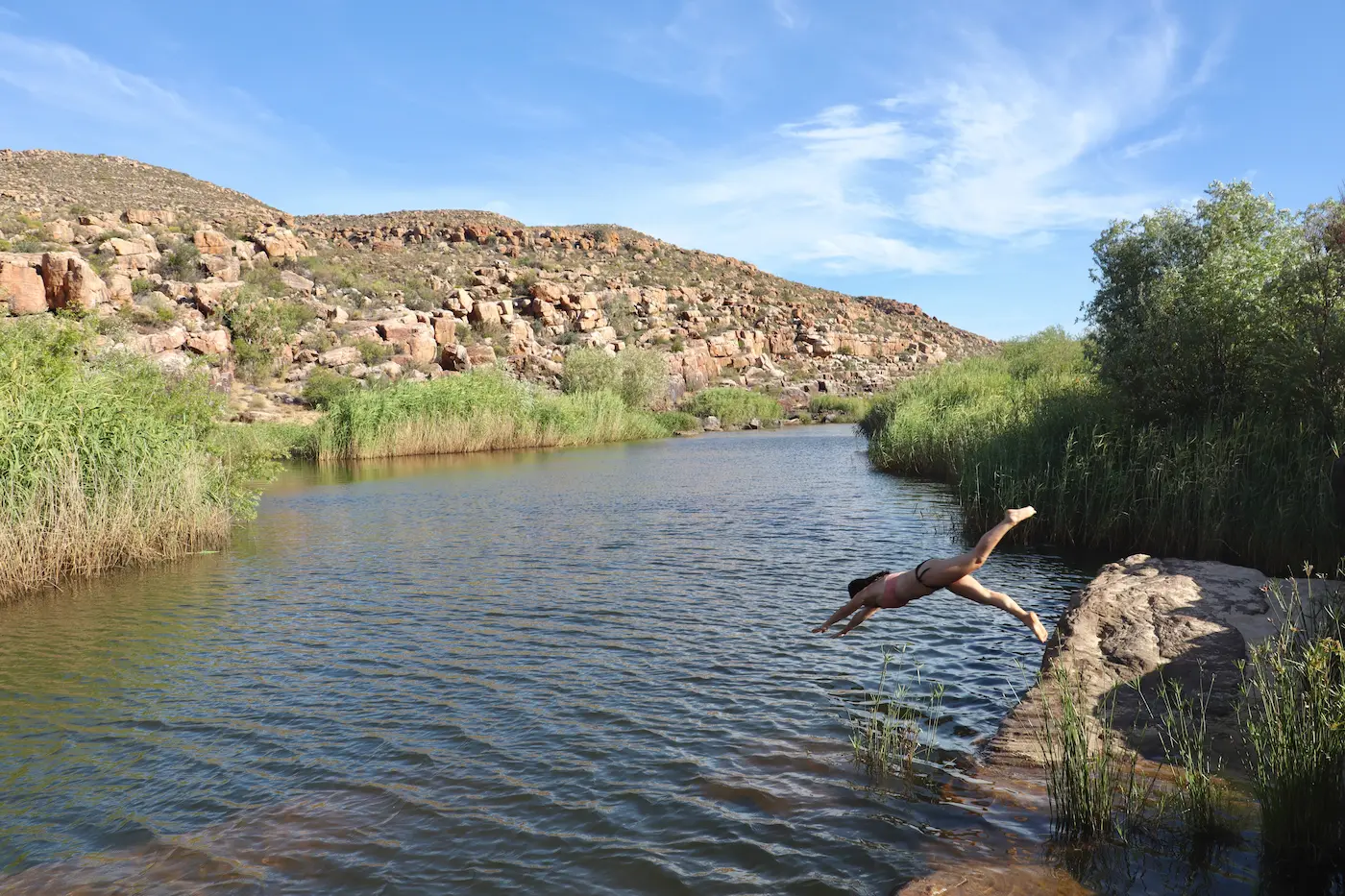
Mornings come in bright. There is cacao, and there is the option of sitting quietly with the others. After that the day opens out. You can walk, and there is a great deal to walk into: 1,350 hectares of rock and Karoo succulents that has been here for longer than is comfortable to think about. You can’t read but you can sit on a warm rock and watch the light move across a valley for an hour and call it a morning well spent, because by the standards of this place it is one.
The meals are the structure. Meals are unhurried. Dinner is at six, every night, and it is more or less the only promise the place makes you. The evenings are beautiful, and the dark, when it finally comes, is total. There is no glow on any horizon, because there is no town for a long way in any direction to make one. People who have not properly seen a night sky since they were children tend to go quiet in a different way when they look up and see the stars.
What if I can’t sit still, or can’t switch off?
Then you are precisely the person these days are built for. The people who struggle most with the silence are usually the ones who needed it most, and they tend to know it, which is its own particular discomfort.
You do not need to meditate. You do not need to be any good at being still, and nobody here is going to hand you a technique and then watch to see whether you have mastered it. The restlessness you feel on the first day is not evidence you are doing it wrong. It is the sound of a nervous system that has been running on a deadline for years, registering for the first time that there isn’t one. It settles, because after a while there is simply nothing left to keep it running.
What I watch happen, month after month
I run these retreats every month, and anyone who knows me knows they are my favourites. The flow barely varies. On arrival, most people feel alone and slightly frightened; they are not used to being around others without talking, and on the first day the mind gets louder before it gets quieter. By the last morning, the same people describe a feeling of belonging, to the group they shared the silence with and, oddly, to the world in general. Something like trust gets rebuilt. I don’t promise this to anyone. I can only tell you it is what I see.
What to bring, and what to leave
Shoes you can walk a long way in. Leave the books at home and the phone in your bag. There is no signal to find, so the decision is made for you, which is a gift most people only recognise on the way home. Leave behind the plan for what the days are supposed to fix, the questions you want to have answered. The ones who arrive with a list of things to resolve tend to leave with the list untouched and a good deal of clarity and new questions to explore.
Is a silent retreat worth it?
That depends on what you are measuring, and on whether you are honest with yourself about what you actually came for.
You will not leave a different person. Anyone who promises you that is selling something. What you might leave with is smaller and more useful than a new self: a few days’ distance from the version of your life that runs entirely on noise, and the slightly inconvenient knowledge of how fast the quiet became normal, and how loud everything had been before it. Most people don’t notice the weight of what they were carrying until they have set it down for a while. They notice it on the drive out, when the signal returns and the phone begins its small avalanche, and for a moment, before they answer the first message, they understand that none of it had followed them up the mountain. It was all still there. It had simply managed without them.
Whether that is worth it is not something we can decide for you. You probably already know.
Common questions
Can you talk at a silent retreat?
You can speak to the staff if you need something, but the day-to-day talking stops. Meals and walks are silent, and most guests find the silence easier than they expected by the second day.
What do you do all day?
Less than usual, on purpose. You can walk the 1,350 hectares, journal, sit, and eat well at set times. There is nothing to fix and nothing you have to be good at.
Is a silent retreat suitable for beginners?
Yes. You do not need any experience with meditation or stillness. The first day’s restlessness is normal, and it settles on its own.