
Why We Don’t Rewild

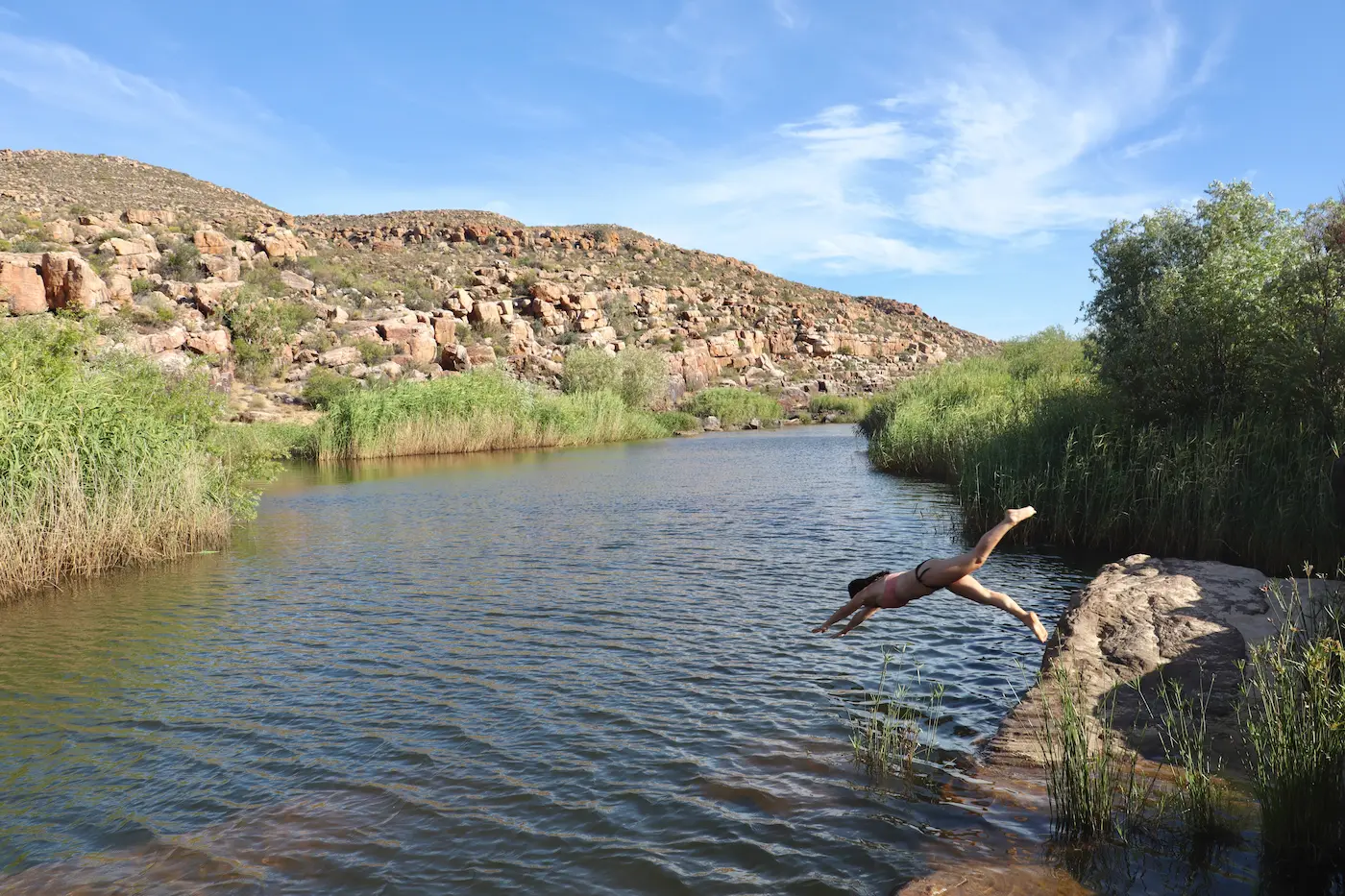
Doring river at bliss and stars

Rewilding usually means putting something back. The predator that was shot out, the grazer that was fenced out, the flood regime that somebody engineered away a century ago and nobody has managed to engineer back since. Where the damage runs that deep the argument is sound, and the people making it are not sentimental about it either. A river dammed at both ends will not undam itself, and a system that has lost its last large carnivore does not grow another one, and waiting for it to do so is not humility so much as a slower kind of neglect.

Our disagreement is with what happened afterwards, when a method built for wrecked ground quietly became a general theory of ground. The assumption running underneath most of what now gets called rewilding is that nature is damaged more or less everywhere, and to more or less the same degree, that recovery is therefore something we administer, and that the shape of the recovered thing is ours to decide in advance. It is a generous view in one direction and a strange one in the other. It gives the natural world a great deal of credit for being ruined and almost none for knowing how to repair itself.

We hold the older position. It is narrower than it sounds, because it only applies to land that still has its parts.

When we went looking for land in South Africa we had a list, and the list was short enough. Dark skies. Water. Remoteness. The silence that is not the absence of sound but the absence of noise. Most of the places we saw had two of those, sometimes three. The Doring River valley had all of them and one thing besides, which was harder to put on a list: the sense that the land had already got on with most of the work.

The farm sits inside the Succulent Karoo, one of only two arid biodiversity hotspots on the planet, holding the richest succulent flora on earth. Forty per cent of the plant species here grow nowhere else. The Doring is the last large free-flowing river in the Cape Fold Ecoregion, undammed along its length, which is to say wild for the unremarkable reason that nobody got round to preventing it. Two endemic fish spawn in our stretch of it. The sandfish, which exists in the Olifants-Doring system and nowhere else, and is endangered. The Clanwilliam yellowfish, near-threatened on the IUCN Red List. The San were here for tens of thousands of years before any of it had a name, and their marks are on the rocks above the river, in places nobody finds unless they are looking. We do not say where.

Self-willed land

There is a tradition holding that the best thing a person can do for land is leave it alone, and it keeps better company than “do nothing” makes it sound. Aldo Leopold defined the health of land as its capacity for self-renewal, and conservation as the work of understanding that capacity and not breaking it. He did not suggest the capacity had to be installed first. Dave Foreman went back to the etymology decades later and pointed out that wilderness descends from older words meaning self-willed land: land with its own way of going about things, permitted to go about them. The word is still the right word. The land is not a machine we operate. It is a process, and we can obstruct it or step out of it.

We stepped out. There is no grazing here, no landscaping, no management plan sitting in a drawer with a five-year horizon on it. We watch what comes back.

What came back
In the five years since we opened, the birds have returned. The klipspringer on the slopes above the chalets have visibly increased, which is the sort of thing you notice without keeping a count. The sandfish and the yellowfish are abundant in our water. None of it is anything we did. It is something we stopped preventing, which is a different sentence and a harder one to take credit for. The land was always capable of this. We got out of the way.

That part is easy to write down and harder to keep doing, because getting out of the way looks, from outside, exactly like neglect, and there is no argument that settles the difference for you. It is a decision made again every season. To make ourselves smaller than the land’s own way of being, and to trust that a return already under way does not need our improving hand laid across the top of it.

The same principle, indoors
We did not set out to run a retreat on a theory of conservation. The link arrived on its own, and it arrived before we had worked out what to do with it. What we ask of guests is what we ask of the land. We invite them to stop managing and improving. instead, give the quieter processes the room they have been denied for years, and see what turns up when nothing is being done to force it.

The conversation you have with yourself  comes back the way the birds came back, because the room was finally there. The necessary pause is that room.

We do not engineer it. We get out of the way, and after that it takes as long as it takes, on a schedule that has never been ours. 

Dave Foreman, Rewilding North America (2004). The modern case for self-willed land, made plainly.

George Monbiot, Feral (2013). The opposite position, argued well. Reading it will tell you where you stand.

The Strange Power of the Eye-Gazing Experiment

Two people sitting face to face during an eye-gazing exercise

Sit down across from the person you know best and say nothing. Look at them, and hold it. Four uninterrupted minutes, past the quick glance and the soft middle-distance focus most conversation runs on. It reads like a mindfulness exercise until you try it, at which point you discover how long four minutes is when you are not performing a version of yourself for anyone, including the person who knows the performance best.
The urge to leave arrives early. The mind starts hunting for an exit, a joke, a reason to check your phone, a stain on the ceiling worth investigating. Anything to break the weight of unstructured presence. And then, usually somewhere around the second minute, something gives. The nervous system stops bracing. The face you arrange for other people slips, and underneath it there is just recognition. Closer to: oh, there you are.

This is not folk wisdom. Arthur Aron’s research on closeness, the work behind the famous 36 questions, found that strangers who moved through an hour of escalating questions felt measurably closer by the end. The four minutes of silent eye contact entered the ritual later, through Mandy Len Catron’s Modern Love essay about trying the method, in whose case it ended in love. Sustained eye contact slows the breath, draws pupils into the same rhythm, and raises oxytocin, the compound the body releases during touch and childbirth. Sometimes it produces tears, drawn out by the unfamiliar intensity of being looked at without being assessed.
Oxytocin does its work quietly. It lowers cortisol, the body’s stress signal, and raises the sense of safety that lets a person stay in a difficult moment instead of leaving it. It works below the level you notice, assembling the conditions for trust before you have decided to extend any.

The posture most of us hold now is the opposite one: angled slightly apart, each lit by a separate screen. Psychologists have a word for the smaller version of this, phubbing, the act of reaching for your phone while the person across from you is still talking. It sounds trivial. The research in Computers in Human Behavior suggests otherwise: it tracks with lower relationship satisfaction, more frequent conflict, and a measurable drop in empathy. We replaced a few thousand years of wordless attention with the flicker of a screen, then began to wonder, sincerely, why the people closest to us feel slightly out of reach.
You don’t have to throw your phone in a river. The observation is smaller and more uncomfortable than that: attention is the rarest thing we have, and we spend almost none of it on each other.

Four minutes leaves the argument you have had five times exactly where it was. It leaves untouched what a relationship accumulates over years. But it can interrupt both for long enough to remember there is a person on the other side. There is an old idea, older than the research by several thousand years, that we become ourselves through being witnessed by others rather than alone. The exercise is a small, slightly awkward rehearsal of exactly that.

So the next time you land in the familiar loop, the same disagreement or the same parallel silence with two phones in it, try the harder thing. Turn toward each other and look, without explaining or solving or filling the silence. Just see what is already there.

The stargazing afterwards is optional. Though it helps, particularly from a part of the Cederberg where the signal drops out entirely and the dark lasts long enough to forget the time. It is where we hold the couples retreat, built for the slow work of making looking at each other ordinary again.

Rejection is a Doorway

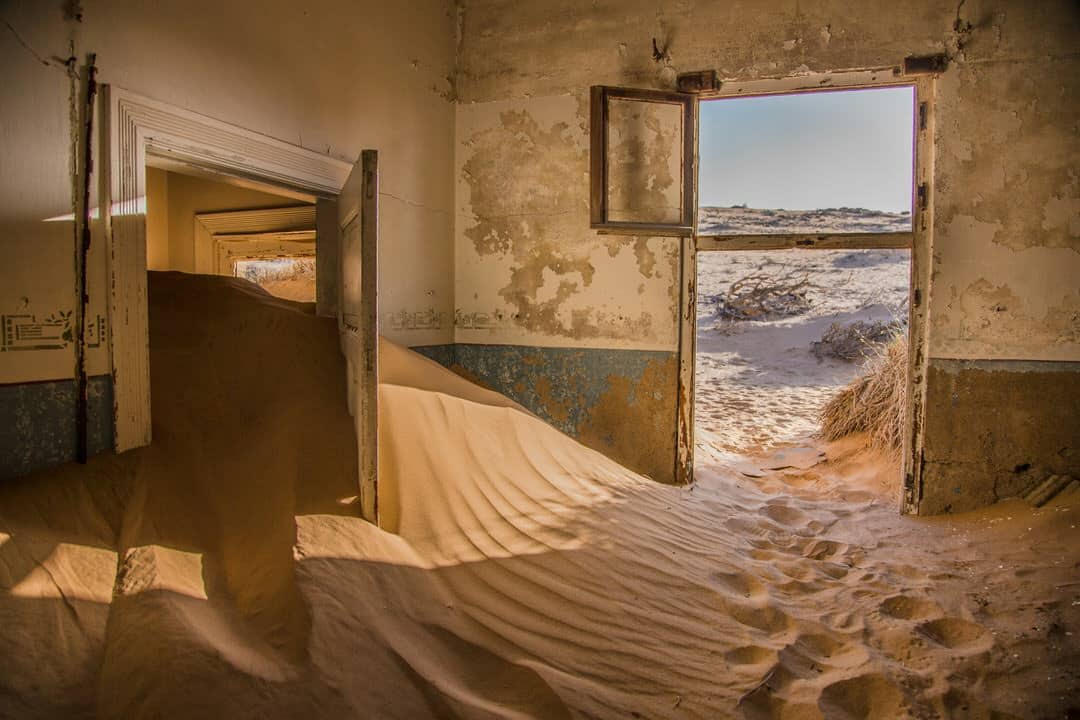
Doorway into a house full of sand

Back in my student days I took a job selling insurance. It was a simple gig to make calls and sell policies. However, for every policy I sold there were countless refusals, and each one was like a tiny dagger. After some time, the rejections stopped feeling like verdicts on me. They became more like weather, something that happens and passes. The more of them I collected, the less each one stung. I didn’t know it at the time, but I was repeating an old experiment.

Summer, 1933, a botanical garden
Albert Ellis, long before he became one of the most influential psychotherapists of the century, was a nineteen-year-old who could not talk to women. He lived near the Bronx Botanical Gardens and would sit on a bench a few feet from a woman on another bench, tell himself the moment was right, and then walk away furious with himself. So in the July before his final year of college he gave himself a homework assignment. Every day it wasn’t raining, he would go to the gardens, and every time he found a woman sitting alone, he would sit down next to her and give himself one minute to speak. To get through the panic he repeated a line to himself that he quoted for the rest of his life: “If I die, I die. Screw it, so I die.”

He didn’t die. He found 130 women alone on benches that month. Thirty stood up and left the moment he sat down. He talked with the other hundred, about birds, flowers, books, whatever arrived. Out of a hundred conversations he got one date. She never showed up.

As results go, that’s a catastrophe. Except the fear was gone. He had met the thing he dreaded well over a hundred times, and it had failed, every single time, to do anything to him. Ellis said later that the month changed his life, and it arguably changed therapy too. What he did on those benches now has a name, exposure, and it is still one of the most reliable tools psychology has for fear.

What a no is made of
Here’s the thing his experiment showed, and mine confirmed on a smaller scale. A no from a stranger is not bad as such. What hurts is the meaning we attach to it, the suspicion that each refusal is a measurement of our worth. Enough volume breaks that suspicion, because after a hundred refusals you are still there, still yourself, and the theory that a no can diminish you has run out of evidence. Most refusals turn out to be about timing, or the other person’s day.

Writing this is a small practice in the same thing. Some readers will scroll past, while some will disagree.

I still don’t like rejection. I doubt Ellis did either, even after his hundred. I’ve just stopped treating a no as a problem. Usually it’s the gateway.

One Year of Life in Wilderness

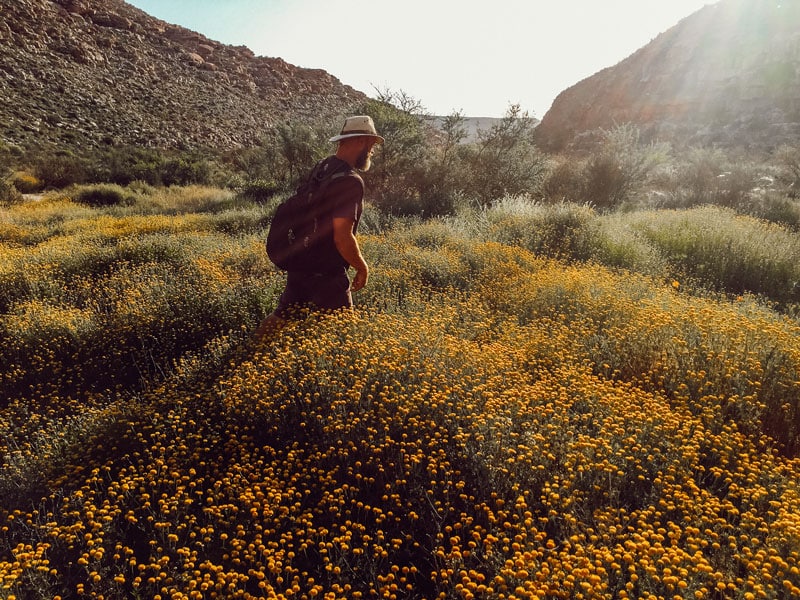
Man walking through the field of yellow flowers

In 2019 we moved to a farm in the Cederberg, three hours north of Cape Town and forty minutes of dirt road from the nearest public road. Time there is measured by the position of the sun. The only reminder of the rest of the world is the occasional jet stripe crossing an otherwise empty sky.

There was one cottage. No electricity, no running water apart from a spring, no internet, no phone signal. The conditions set the rhythm of our days before we had any say in it: up with the sunrise, asleep not long after sunset, connected to each other and the land because there was nothing else to be connected to.

Needs without buttons

Modern life satisfies most needs at the push of a button, which is convenient, and also how you lose track of where anything comes from. Living without the buttons was the most interesting deprivation we have tried. Water arrived because we had piped it from the spring. Light arrived because the sun had charged the batteries. When a tap first ran, or a bulb first lit, the satisfaction was out of all proportion to the event, because we knew every joint and cable behind it, and because the environment that made it possible is the same one that could have crushed the whole attempt.

A municipality of two

Slowly the place took shape. A solar plant. A water system for showers, baths and the gardens. Waste management, because nobody else collects it here. In effect we built a miniature municipality, and then five chalets on top of it. That place became Bliss & Stars.

The year supplied a steady run of problems: baboons eating the watermelons, cars breaking down, mice chewing through cables, dogs chasing snakes, a road dispute, suppliers letting us down, building materials running out in the middle of lockdown. The bush is beautiful and it is also brutal, and it does not much care which one you were expecting that day.

It was the most stressful year we had attempted, corporate careers included. We had also never felt more free. We have been sitting with that contradiction ever since.