
Why We Don’t Rewild

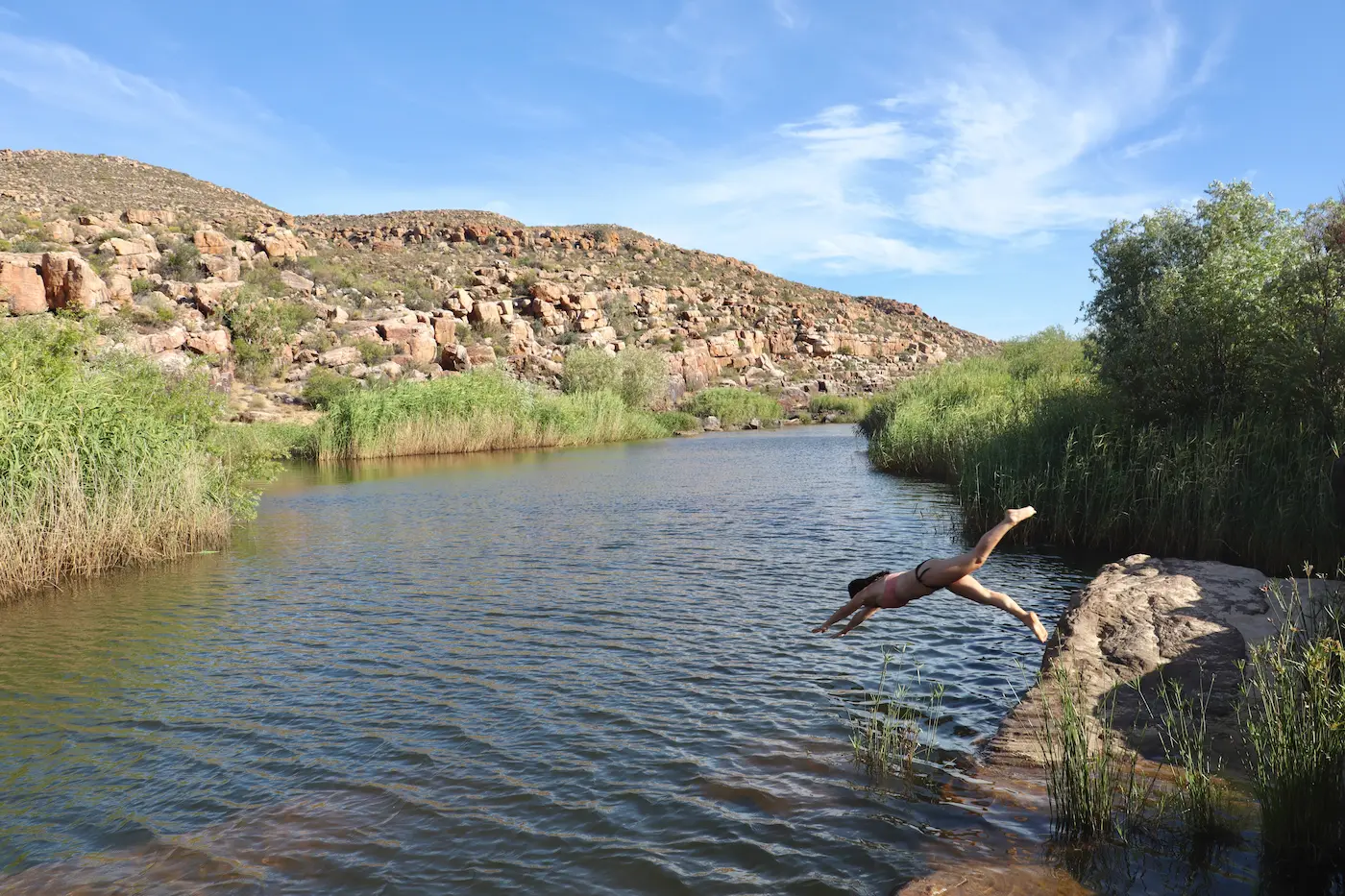
Doring river at bliss and stars

Rewilding usually means putting something back. The predator that was shot out, the grazer that was fenced out, the flood regime that somebody engineered away a century ago and nobody has managed to engineer back since. Where the damage runs that deep the argument is sound, and the people making it are not sentimental about it either. A river dammed at both ends will not undam itself, and a system that has lost its last large carnivore does not grow another one, and waiting for it to do so is not humility so much as a slower kind of neglect.

Our disagreement is with what happened afterwards, when a method built for wrecked ground quietly became a general theory of ground. The assumption running underneath most of what now gets called rewilding is that nature is damaged more or less everywhere, and to more or less the same degree, that recovery is therefore something we administer, and that the shape of the recovered thing is ours to decide in advance. It is a generous view in one direction and a strange one in the other. It gives the natural world a great deal of credit for being ruined and almost none for knowing how to repair itself.

We hold the older position. It is narrower than it sounds, because it only applies to land that still has its parts.

When we went looking for land in South Africa we had a list, and the list was short enough. Dark skies. Water. Remoteness. The silence that is not the absence of sound but the absence of noise. Most of the places we saw had two of those, sometimes three. The Doring River valley had all of them and one thing besides, which was harder to put on a list: the sense that the land had already got on with most of the work.

The farm sits inside the Succulent Karoo, one of only two arid biodiversity hotspots on the planet, holding the richest succulent flora on earth. Forty per cent of the plant species here grow nowhere else. The Doring is the last large free-flowing river in the Cape Fold Ecoregion, undammed along its length, which is to say wild for the unremarkable reason that nobody got round to preventing it. Two endemic fish spawn in our stretch of it. The sandfish, which exists in the Olifants-Doring system and nowhere else, and is endangered. The Clanwilliam yellowfish, near-threatened on the IUCN Red List. The San were here for tens of thousands of years before any of it had a name, and their marks are on the rocks above the river, in places nobody finds unless they are looking. We do not say where.

Self-willed land

There is a tradition holding that the best thing a person can do for land is leave it alone, and it keeps better company than “do nothing” makes it sound. Aldo Leopold defined the health of land as its capacity for self-renewal, and conservation as the work of understanding that capacity and not breaking it. He did not suggest the capacity had to be installed first. Dave Foreman went back to the etymology decades later and pointed out that wilderness descends from older words meaning self-willed land: land with its own way of going about things, permitted to go about them. The word is still the right word. The land is not a machine we operate. It is a process, and we can obstruct it or step out of it.

We stepped out. There is no grazing here, no landscaping, no management plan sitting in a drawer with a five-year horizon on it. We watch what comes back.

What came back
In the five years since we opened, the birds have returned. The klipspringer on the slopes above the chalets have visibly increased, which is the sort of thing you notice without keeping a count. The sandfish and the yellowfish are abundant in our water. None of it is anything we did. It is something we stopped preventing, which is a different sentence and a harder one to take credit for. The land was always capable of this. We got out of the way.

That part is easy to write down and harder to keep doing, because getting out of the way looks, from outside, exactly like neglect, and there is no argument that settles the difference for you. It is a decision made again every season. To make ourselves smaller than the land’s own way of being, and to trust that a return already under way does not need our improving hand laid across the top of it.

The same principle, indoors
We did not set out to run a retreat on a theory of conservation. The link arrived on its own, and it arrived before we had worked out what to do with it. What we ask of guests is what we ask of the land. We invite them to stop managing and improving. instead, give the quieter processes the room they have been denied for years, and see what turns up when nothing is being done to force it.

The conversation you have with yourself  comes back the way the birds came back, because the room was finally there. The necessary pause is that room.

We do not engineer it. We get out of the way, and after that it takes as long as it takes, on a schedule that has never been ours. 

Dave Foreman, Rewilding North America (2004). The modern case for self-willed land, made plainly.

George Monbiot, Feral (2013). The opposite position, argued well. Reading it will tell you where you stand.

The Harder You Work, The Worse You Think

A woman wrapped in a blanket reads a book beside floor-to-ceiling windows framing the rocky Cederberg landscape

There is a puzzle psychologists have been handing to people since the 1940s, and almost everyone fails it the same way. You are given a candle, a box of drawing pins, and a book of matches, and asked to fix the candle to the wall so that it burns without dropping wax on the floor. People try to pin the candle directly to the wall. They try to melt one side and stick it. Neither works, and they sit there turning the same three objects over, certain the answer is somewhere in the candle. It isn’t. The answer is to tip the pins out of the box, pin the empty box to the wall, and stand the candle inside it. The box was a shelf the entire time. The only reason it takes so long is that the box arrives full of pins, and a box full of pins is a container, and a container does not become a shelf until you decide it can.

Karl Duncker built that puzzle in 1945, and psychologists have been quietly running it ever since under the duller name of functional fixedness, the mind’s habit of seeing an object only as the thing it usually is. What matters here is not the puzzle. It is the discovery, made decades later, that the odds of solving it have very little to do with intelligence or effort, and a great deal to do with the state you happen to be in when you sit down.

In 1962 Sam Glucksberg ran the candle problem with a twist. He offered one group money to solve it quickly, a cash prize for the fastest times, the kind of incentive every workplace runs on. They were measurably slower than the group offered nothing. The reward narrowed them. It pulled their attention onto the obvious features of the objects and away from the strange one, the box, which was exactly where the answer lived. Twenty years later Alice Isen ran a gentler version. Before handing people the puzzle she gave some of them a small bag of sweets, or showed them a few minutes of a comedy film, nothing more than a minor lift in mood. Those people solved it faster and more flexibly than the rest. A good mood did what a cash prize could not.

This is the finding the productivity industry has spent the last few years discovering, repackaging, and selling back to exhausted people as a technique. The version most people have met by now comes from a young doctor turned productivity author who, on the edge of burning out as a junior medic, noticed the research and built a bestseller on it. The headline is appealing and mostly true: feeling good is not the reward for good work, it is the precondition for it. Barbara Fredrickson spent the late 1990s demonstrating exactly this, that positive states physically widen the aperture of attention, let more information in, and accumulate over time into durable reserves of resilience and range. The clenched mind is a narrow mind. The narrow mind misses the box.

You can see the same thing in the people who do the most consequential work of all. Richard Feynman traced his Nobel back to an afternoon spent watching a plate wobble in the air over a cafeteria, a problem nobody had set him and nothing depended on, which is precisely why he could think about it freely enough to find the rotation that later fed his work on quantum electrodynamics. Alexander Fleming described what he did as playing with microbes. Andre Geim and Konstantin Novoselov isolated graphene during what they called their Friday-night experiments, the hours they set aside to mess about with questions that had no deliverable attached. Ask any of them how it happened and they describe play, not grind. The grind is what the rest of us do to the work after the interesting part is over.

There is a researcher, Stuart Brown, who has spent a career arguing that play is not the opposite of work but the condition that makes good work possible, and that adults never lose their play temperament, they just stop being allowed to use it. And there is a study from 2020, run jointly by NYU and the University of Miami, that tracked people’s movements by phone and found that those who simply varied their days, a different route to the office, an unfamiliar café, reported more happiness and less of the flat grey that arrives before burnout does. None of this is exotic. It is the ordinary human range, the one that gets switched off first when the pressure goes up.

Which is where the productivity reading of all this falls apart. The genre takes the research and turns it into one more thing to manage. Schedule a side quest. Gamify the spreadsheet. Build delight into your sprint. The burned-out executive reads the play studies at eleven at night and resolves, tomorrow, to make the work fun, and in doing so adds a fifteenth item to a list of fourteen that already isn’t getting done. The studies do not say add play to a clenched system. They say the clenched system is the problem, and that you cannot instruct yourself into ease from inside the conditions that removed it. A reward could not buy Glucksberg’s people out of their own narrowness. Telling yourself to relax is just another reward.

What changes the state is almost never a technique. It is the removal of the conditions that produced it. That is the one thing no productivity book can give you, because the conditions are mostly the room you go back to on Monday, and they do not loosen because you have decided to be more playful inside them. They loosen when you are no longer in the room.

Meditation Isn’t About Stopping Your Thoughts

Daria Rasmussen - silent retreat at Bliss and Stars, Cederberg, South Africa

There are people who has decided, with lots of confidence, that meditation is not for them. They have usually tried it once. They sat down, closed their eyes, and within about forty seconds found themselves drafting an email, relitigating a conversation from 2019, or wondering whether they turned the stove off. They concluded, reasonably, that they had failed at it, and that the failure said something permanent about their wiring. 
This is the most common reason people give for not meditating, and it rests on a misunderstanding so widespread it has become the default. The belief is that meditation means stopping your thoughts. That somewhere out there are calm, evolved people whose minds go silent on command, and that you, with your forty seconds and your stove, are simply not one of them.
Nobody’s mind goes silent on command. That was never the thing.

The restless mind is not a personal failing
The mind does not want to be still. It was not built to be still. Left to itself it produces thought the way the body produces heat, continuously and without being asked, and most of that thought is repetitive, unfinished, and faintly anxious. You did not break it with your phone, though the phone has not helped. The restlessness is older than that. Contemplatives noticed it thousands of years ago and described it in the same exasperated terms people use now, comparing the untrained mind to a drunk monkey, or a horse that has never been ridden, or a room full of people all talking at once.
So when you sit down and your mind immediately starts its noise, you are not doing it wrong. You are encountering the thing as it actually is, possibly for the first time, because most of the day you are too occupied to notice the noise is even running. The noise is always running. Meditation just turns down everything around it so you can finally hear it.

You cannot stop the waves
There is a line from the meditation teacher Jon Kabat-Zinn that gets repeated in this context: you cannot stop the waves, but you can learn to surf.
The point of sitting is not to flatten the ocean. The ocean does not flatten. The point is to stop being surprised every time a wave arrives, and to stop treating each one as evidence that you have failed. The thought comes, you notice it has come, you return your attention to wherever you had it before. The thought comes again, you notice again, you return again. That return, done quietly and without self-recrimination, repeated more times than you can count, is not the warm-up. It is the entire practice. There is nothing else hiding behind it.
People who have done this for years still have busy minds. What they have is a different relationship to the busyness. They have stopped believing every thought is an instruction. They notice the mind reaching for the pleasant thing and bracing against the unpleasant one, and they have learned that both are just weather, and that weather passes whether or not you grip it. This is a quietly useful thing to know at eleven at night when the mind has decided to review your entire professional life.

Start small
The other reason people abandon meditation is that they begin with an ambition wildly out of proportion to the act. They decide they will sit for thirty minutes, fail at twenty-five of them, and quit.
Five minutes is enough to begin. Genuinely enough, not a consolation prize. Five minutes a day, the same five minutes, sat through whether or not it goes well, will do more than an occasional heroic hour. The duration extends on its own once the habit stops feeling like a negotiation, and not before.
If you want something to actually do, the simplest version is the oldest one. Sit with a reasonably straight back, on a chair or the floor, whichever you will actually return to tomorrow. Let the eyes close or rest half-open and unfocused. Find your breath without changing it, and just follow it, in and out. Count if it helps, one on the exhale, up to ten, then start again at one. When you notice the mind has wandered off into planning or rehearsing or remembering, and you will notice this constantly, bring it back to the breath. That noticing and returning is the repetition that does the work. You are not failing each time you wander. The wandering and the returning are the same muscle.

Where the silence stops being a technique
Five minutes at your kitchen table is one thing. Days of it, somewhere with no signal and nothing asking for you, is another order of experience entirely, and not because anything mystical happens. It is just that the noise around you finally drops low enough, and stays low enough, for long enough, that the noise inside has nowhere to hide. Most people find that uncomfortable for about two days. What comes after the discomfort is the part that is difficult to describe to anyone who hasn’t sat in it.

Rest & Thrive is built around that drop in volume. No phone signal, a maximum of ten guests, 1,350 hectares of the Cederberg doing the work that no amount of instruction can. You do not need to arrive knowing how to meditate. The restless mind you would bring with you is the only qualification, and you already have that.

The waves were always going to keep coming. You were never meant to stop them.

The Strange Power of the Eye-Gazing Experiment

Two people sitting face to face during an eye-gazing exercise

Sit down across from the person you know best and say nothing. Look at them, and hold it. Four uninterrupted minutes, past the quick glance and the soft middle-distance focus most conversation runs on. It reads like a mindfulness exercise until you try it, at which point you discover how long four minutes is when you are not performing a version of yourself for anyone, including the person who knows the performance best.
The urge to leave arrives early. The mind starts hunting for an exit, a joke, a reason to check your phone, a stain on the ceiling worth investigating. Anything to break the weight of unstructured presence. And then, usually somewhere around the second minute, something gives. The nervous system stops bracing. The face you arrange for other people slips, and underneath it there is just recognition. Closer to: oh, there you are.

This is not folk wisdom. Arthur Aron’s research on closeness, the work behind the famous 36 questions, found that strangers who moved through an hour of escalating questions felt measurably closer by the end. The four minutes of silent eye contact entered the ritual later, through Mandy Len Catron’s Modern Love essay about trying the method, in whose case it ended in love. Sustained eye contact slows the breath, draws pupils into the same rhythm, and raises oxytocin, the compound the body releases during touch and childbirth. Sometimes it produces tears, drawn out by the unfamiliar intensity of being looked at without being assessed.
Oxytocin does its work quietly. It lowers cortisol, the body’s stress signal, and raises the sense of safety that lets a person stay in a difficult moment instead of leaving it. It works below the level you notice, assembling the conditions for trust before you have decided to extend any.

The posture most of us hold now is the opposite one: angled slightly apart, each lit by a separate screen. Psychologists have a word for the smaller version of this, phubbing, the act of reaching for your phone while the person across from you is still talking. It sounds trivial. The research in Computers in Human Behavior suggests otherwise: it tracks with lower relationship satisfaction, more frequent conflict, and a measurable drop in empathy. We replaced a few thousand years of wordless attention with the flicker of a screen, then began to wonder, sincerely, why the people closest to us feel slightly out of reach.
You don’t have to throw your phone in a river. The observation is smaller and more uncomfortable than that: attention is the rarest thing we have, and we spend almost none of it on each other.

Four minutes leaves the argument you have had five times exactly where it was. It leaves untouched what a relationship accumulates over years. But it can interrupt both for long enough to remember there is a person on the other side. There is an old idea, older than the research by several thousand years, that we become ourselves through being witnessed by others rather than alone. The exercise is a small, slightly awkward rehearsal of exactly that.

So the next time you land in the familiar loop, the same disagreement or the same parallel silence with two phones in it, try the harder thing. Turn toward each other and look, without explaining or solving or filling the silence. Just see what is already there.

The stargazing afterwards is optional. Though it helps, particularly from a part of the Cederberg where the signal drops out entirely and the dark lasts long enough to forget the time. It is where we hold the couples retreat, built for the slow work of making looking at each other ordinary again.